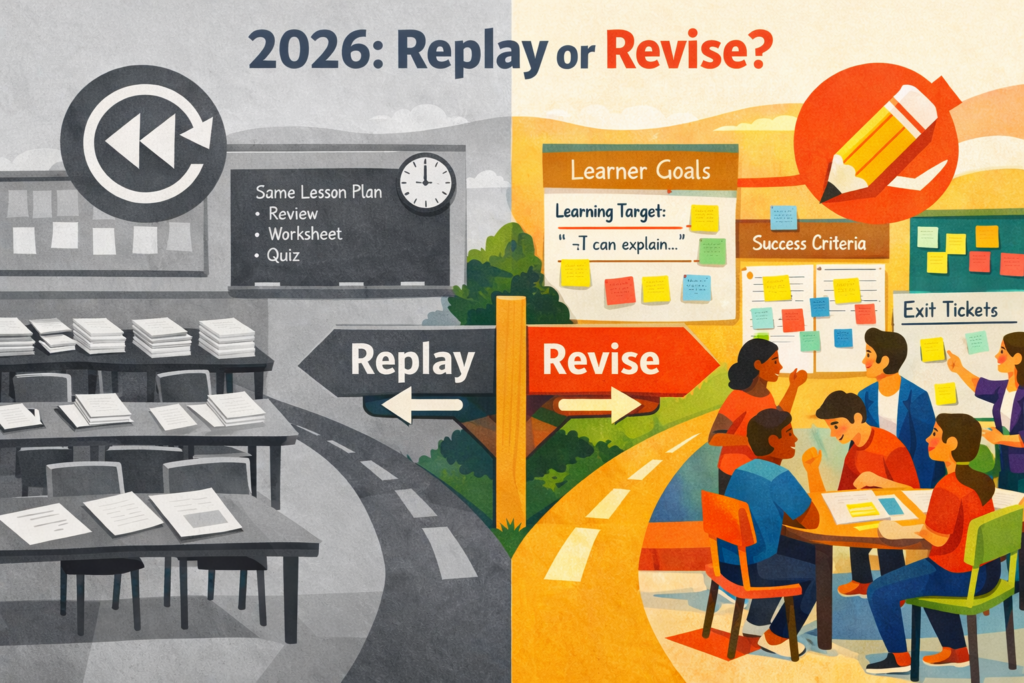
January does what January does. Parking lots at the gym overflow. New journals crack open. We swear off sugar, swear in kale, swear we’ll finally keep a routine or long-term goal. Schools do it, too: fresh calendars, fresh bulletin boards, fresh PD slides. And then the “fresh” wears off. The treadmill clears out. The journal gathers dust. The diet meets the dessert menu. Every year hands us the same fork in the road: Replay what we did last year or revise and make true change happen. Educators, that choice is ours, right now.
When and Why Replay is Easier
Replay is the path that greets us at the door because it already knows our names. It fits like a favorite jacket and asks for almost nothing in return. We can run last year’s sequence without pausing to think about the friction points or the missed opportunities. The pacing guide tells us where to stand and what to say. The routines sit ready. Bell rings. Warm up. Mini lesson. Practice. Collect. It all moves with a reassuring rhythm that promises control and calm. In that rhythm, adults feel productive. The room is orderly. Work is completed. Grades go in on time. It looks like progress even when the learning beneath the surface remains shallow.
Replay thrives when comfort outruns clarity. Teaching becomes the activity and learning becomes the assumption. We feel safe because we can predict what will happen. Learners will sit where they are told, take out what they are told, and finish what they are told. The metrics reward coverage and compliance. We finished the unit. We gave the test. We recorded the scores. Coverage feels like success because it is visible and countable. Mastery asks harder questions. Did the learner understand the idea well enough to use it in a new context? Can the learner explain the why behind the steps? Those questions push us to examine our impact and that can be uncomfortable.
Replay also grows in the soil of initiative fatigue. New names for old moves arrive each year. A shiny platform promises transformation while the tasks inside stay identical to last year’s worksheets. We swap the container and keep the contents. After a few cycles of this, our energy contracts. We quietly choose the version of change that requires the least rethinking. We change fonts. We add a timer. We keep the task. The learning stays the same. Add the ever present squeeze of time. It is faster to plan what we will say than it is to design what learners will do that will actually show the learning. When the clock is loud, replay whispers that a familiar slide deck will save the day.
There is another reason replay holds on. Evidence has a way of speaking plainly. When we gather real artifacts of learning and put them beside clear criteria, gaps show. That is not a failure. That is the invitation to design. But it can feel personal. It is easier to measure completion and move on than to confront the distance between what we taught and what learners can now do. Replay helps us avoid that mirror. Revision asks us to look into it.
Most of all, replay persists because last year seemed to work well enough. We remember the smooth days and the compliant silence. We forget the learners who were present in body and absent in mind. We tell ourselves that a tweak counts as a change. We expect learners to evolve while our own practice changes by inches. Replay keeps adults comfortable. It does not keep learning moving.
How to Revise on Purpose
Revision begins when we examine our impact with honesty and decide to start small. Pick one upcoming lesson or one unit or even one day. Name the learning in words a learner can say back without guessing. What am I learning, why does it matter, how will I know I learned it. Put that target where eyes and minds can find it, then return to it during the period. Design a task that lets learners show the learning rather than simply finish a task. If the goal is argument, ask for a claim with evidence and reasoning that a peer can follow. If the goal is conceptual understanding in science, ask for a model of the system with annotated cause and effect. If the goal is mathematical thinking, ask for a solution with justification and a comparison of two methods, followed by a decision about which generalizes and why. Layer in success criteria that are concrete and observable. Not be too detailed, but includes relevant and accurate pieces of evidence and explains how each supports the claim. Now learners can self assess and peer assess without waiting on us.
Plan quick formative checks that fit inside the lesson and change what happens next. An entrance prediction you revisit at the end. A stop and jot in the middle that targets the core idea. A two minute gallery walk with sticky notes that use the language of the criteria. Keep feedback short, specific, and forward focused so it can be used immediately. You met the first criterion by citing two sources. Next, address the second by explaining the connection between each source and your claim. Aim to deliver feedback before the bell so a revision move happens while thinking is still warm. Track the talk ratio once and be brave. If we are doing most of the talking, we are doing most of the thinking. Build in structured talk that guarantees participation. Think alone, write a bit, then share with a partner using a sentence stem tied to the target. Close by measuring impact, not intention. Ask three learners what they learned, how they know, and what they will improve next. If they can answer and show evidence, the revision is working. If not, adjust tomorrow. No guilt. Just a design tweak.
Choose one initiative area that multiplies effort. Maybe teacher clarity so targets and success criteria stay in focus. Perhaps formative evaluation that is small, frequent, and actionable. Quality tasks that produce evidence of learning. Or maybe feedback and revision used during class, not after grades. And even learner discourse that engages every voice, not the usual few. You do not need ten new strategies. You just need one high leverage move used well and used often.
The gyms will thin. The journals will go quiet. Resolutions will try to bargain with reality. That is the pattern. What is not predetermined is our decision in classrooms today. Replay offers comfort and hopes for different results. Revision designs for learning and makes progress visible. Will 2026 be another replay year? Or will we choose to use this year to revise and rejuvenate our craft to take this year’s learning to the next level?