We say we want comprehension. We say we want critical thinking. We say we want learners to go deeper. But too often, we skip the part that makes all of that possible in the first place. Knowledge. And one of the clearest pathways into knowledge is vocabulary.
That is why the way we have handled vocabulary for years should concern us. Too often, it has been reduced to lists, worksheets, copied definitions, and weekly tests. Words on Monday. Quiz on Friday. Forgotten by Tuesday. That is not meaningful learning. That is short term exposure dressed up as instruction.
If learners do not know the words, they cannot fully access the ideas. If they cannot access the ideas, they cannot connect them, explain them, or think deeply about them. Vocabulary is not extra. It is foundational.
Vocabulary Should Build Understanding, Not Just Recall
For too long, vocabulary instruction has been treated like a side task. Something separate from the real learning. Something to get through before the lesson begins. That mindset has done real damage.
When learners are asked to memorize a definition, match a term, or study for a test, they may remember enough to survive the quiz. But that is not the same as owning the word. Ownership means they can use it accurately in context. They can connect it to ideas. They can explain it, apply it, and recognize it when it shows up in new situations.
That kind of vocabulary learning does not happen through one and done exposure. It happens through repeated encounters, meaningful use, and strong connections to content. Learners need to hear the word, say the word, write the word, and use the word while thinking. They need to see how words relate to each other and to the topic they are studying. They need to do more than define. They need to make meaning.
This is where a lot of vocabulary instruction breaks down. It focuses on recognition instead of use. It values speed over depth. It confuses memorization with understanding. But words are not just labels. They carry concepts. They organize thinking. They open doors into content. When vocabulary instruction is rich, learners are not just collecting terms. They are building the language they need to learn.
Background Knowledge Is What Makes Critical Thinking Possible
We often talk about critical thinking as though it is a generic skill that can be turned on at any moment. Ask a few good questions. Add some rigor. Put analyze or evaluate at the top of the task. Done.
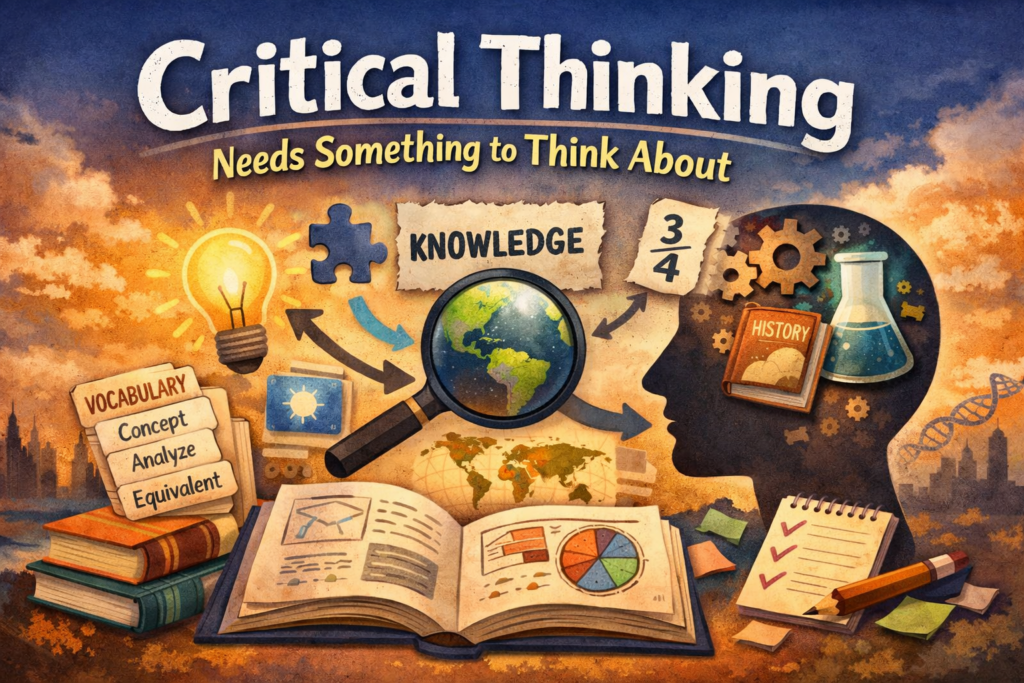
Except it does not work like that. Critical thinking depends on knowledge. Learners cannot think deeply about a topic they know little about. They cannot analyze ideas they do not understand. They cannot make strong judgments about content they cannot access. Thinking has to work on something. Knowledge is that something.
This is especially important for comprehension. Reading is not just about decoding words on a page. It is about making sense of ideas. Background knowledge helps learners interpret information, make inferences, connect details, and hold meaning together. Without it, even a strong reader can struggle. With it, comprehension becomes more possible because the learner has something to attach the new learning to.
The same is true across content areas. In science, background knowledge gives meaning to observations and claims. In social studies, it provides the context needed to understand causes, systems, and change over time. In math, it supports reasoning because the language of mathematics matters more than we sometimes admit. Words like equivalent, estimate, justify, compare, and represent are not decorative. They shape the thinking.
So when we ask learners to think critically, we cannot stop at the prompt. We have to ask whether they have the knowledge base to do the thinking we want. If they do not, then more rigor will not solve the problem. Better knowledge building will.
A Better Way Forward With Vocabulary-Rich Tasks
That is why I am excited about the FREE Vocabulary-Rich Task Creator. Find it on the AI Tools Slide Deck on my webpage.
This tool does not treat vocabulary as an isolated routine. It helps teachers design learning experiences where vocabulary is embedded inside the content and tied directly to the learning target. Instead of copying definitions, learners engage in tasks that ask them to connect words, explain ideas, represent thinking visually, speak with precision, and apply vocabulary in meaningful contexts.
That matters because it reflects how learning actually works. Strong vocabulary instruction should involve multiple exposures, retrieval, elaboration, and application. Learners should revisit words, not just meet them once. They should use words in speaking and writing, not just circle them on a worksheet. They should connect words to concepts and to each other so the language becomes part of their thinking.
The tool helps make that possible. It creates activities that move beyond low level recall and toward real understanding. It gives teachers a practical way to turn vocabulary into something learners actively use. Something visible. Something connected to knowledge building.
And that is the shift we need. If we want stronger comprehension, we need stronger knowledge building. If we want stronger knowledge building, we need better vocabulary instruction. Not more lists. Not more quizzes. Better design.
Because learners cannot think critically about what they do not know. But when we build vocabulary with intention, when we connect words to ideas, and when we give learners repeated opportunities to use language in meaningful ways, everything starts to change. The words stick. The understanding deepens. The thinking gets better, and that is the point.