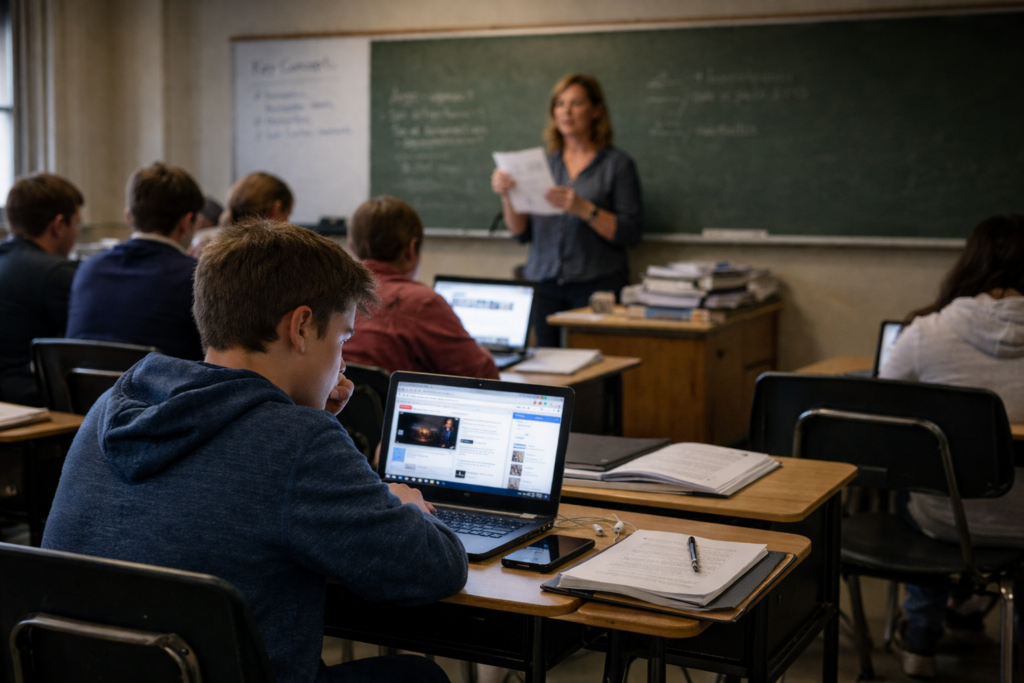
This is a follow up to my recent post on Let’s Quit Teaching entitled, When the Glow Impedes the Grow, where I described the familiar illusion: a quiet room, screens up, everyone “on task,” and almost no one able to say what they learned, why it matters, or how they know. When device use becomes the default medium for core learning, reading can slide toward skimming, attention fractures under constant temptation, and performance tends to drift the wrong way, especially when screens are open ended and unsupervised.
This week, neuroscientist Dr. Jared Horvath testified before Congress and argued that Gen Z may be the first modern cohort to miss the usual generational lift in cognitive performance. In other words, Gen Z is the first generation to not display greater intelligence than the previous one. He connects that stall to the era when screens became the default environment for school, not an occasional tool. If a learner spends the bulk of the day toggling, scrolling, and sampling information in thin slices, we should not be surprised when stamina for deep reading, sustained reasoning, and durable recall starts to weaken.
So this piece is for all the teachers living in the gap between access and purpose. We handed out devices, but we did not hand out a shared definition of when a screen should earn its minutes. We installed platforms, but we did not consistently protect the conditions learning needs most: attention, friction, talk, retrieval, and visible thinking. The goal here is not to demonize technology. It is to make it useful again by putting it back where it belongs, in service of learning, not in the driver’s seat. We gave out devices. We did not teach purpose.
We Gave the Tool, Not the Conditions
Buttons were never the missing piece. Most tech training has lived at the level of clicks and workflows. How to push an assignment. How to open a platform. How to monitor a screen. Teachers can learn buttons. Learners can learn buttons. What many rollouts skipped was the cognitive training, the design logic that decides when a screen helps learning and when it quietly erodes it. Because a device is not instruction, it is amplification.
If the task is digital worksheets, it amplifies compliance. If the work is copy and paste, it amplifies shallow learning. If the norm is distraction, it amplifies distraction. Horvath’s testimony to the U.S. Senate makes that structural argument directly, claiming that increased classroom screen exposure is generally associated with weaker outcomes, with only narrow exceptions under tightly constrained use.
OECD data lands in the same neighborhood from a different angle. A majority of learners report being distracted by devices in class, and that distraction is associated with lower performance, on the order of a large chunk of a school year in math.
So if you have felt the mismatch, a calm room that produces thin learning, you are not imagining it. You are watching a classroom tool become a classroom environment. The goal is not to ban technology. The goal is to rebuild conditions where learning can actually take root.
The Purpose Filter
A simple question that changes your classroom fast. Before the screen opens, ask this. “What can this device do here that paper, a whiteboard, and a human conversation cannot do as well?” If the honest answer is not much, close the device. Not forever. Not as punishment. Simply because attention is expensive and learning requires it.
This one question gives you a defensible, repeatable way to reduce screen time without turning your classroom into a debate about vibes. It also helps learners see technology as a tool you choose, not a background you tolerate.
When the goal is comprehension, reasoning, and retention, paper often wins because it supports sustained attention and deeper processing. When the goal is collaboration, creation, or carefully structured research, the device can be the best tool in the room. That is the whole game. Purpose earns minutes. And the purpose should always point to learning.
Practical Moves to Reduce Screen Time
Start by turning device use into windows, not wallpaper. Open ended device time is where the learning leaks, even for motivated learners, because the environment is built for switching and wandering. Design short on purpose windows tied to a single function, then close them just as explicitly. Devices up to gather sources, then devices down to annotate, discuss, and synthesize. Devices up to draft and revise, then devices down for spoken feedback and clarification. This is not about control. This is about protecting the part of the lesson where meaning is constructed.
Next, rebuild print as a thinking tool for anything long, complex, or inference heavy. Give learners a text on paper that stays put. A page with location. A paragraph that can be boxed. A claim that can be challenged in the margin. The point is not paper for paper’s sake. The point is reducing skim behavior and restoring depth. OECD notes that leisure oriented device use at school is strongly negatively related to learning outcomes, which is a polite way of saying that unstructured screen exposure competes with comprehension.
Then bring back handwriting where memory matters. Not as nostalgia, as a cognitive strategy. If you want ideas to stick, require the first pass of thinking to be slow enough to encode. Notes, summaries, concept maps, worked examples, quick writes, all on paper. Archive later if you need digital storage, but let the learning phase be analog. The broader point aligns with what was raised in the original post. Cognition favors friction. When everything is frictionless, there is very little that sticks.
Shift notes away from capturing and toward retrieval. Begin class with a blank page recall routine. Two minutes. No resources. Write what you remember from the last lesson. Then compare with a partner and refine with the learning target. This one move reduces device dependence while strengthening memory because it forces the mind to retrieve rather than review.
Finally, make talk non negotiable. Screens isolate, even in a full room. Build a requirement that understanding must pass through another human before it counts as finished. A claim must be spoken before it is written. A solution must be explained before it is submitted. A paragraph must be defended verbally before it is polished. The device can collect the final product, but the learning happens in the struggle to explain clearly.
Point to the Purpose
Purpose is the upgrade we skipped when it comes to technology in the classroom. If Horvath is even partly right, if this era is producing a measurable gap in the cognitive lift we assumed was automatic, then the fix is not another platform. It is not faster devices. It is not more digital minutes disguised as rigor. The fix is restoring the conditions that grow literacy, numeracy, and reasoning: sustained attention, deep reading, retrieval, writing that forces thinking, and talk that demands clarity.
We can still use technology. Use screens when they truly upgrade collaboration, creation, or research. Use paper, pens, boards, and conversation as the default for the heavy lifting of learning. Then your classroom stops chasing the next tab and starts building something that lasts. Less glow of the screens. More growth of the learning.