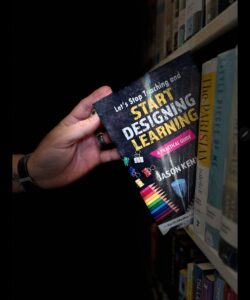

Imagine if you will: You’re in the middle of a staff meeting, droning on about curriculum updates, and suddenly you catch yourself zoning out, scrolling through your phone under the table, or whispering to the colleague next to you about weekend plans. Sound familiar? Now flip that script to your classroom, where a room full of fidgety middle schoolers is doing the exact same thing (doodling, chatting, or sneaking peeks at their devices) while you’re up front delivering a lecture on the solar system. If we’re honest, traditional teaching sets the stage for this chaos, turning classrooms into battlegrounds of boredom and misbehavior.
My first two reasons for quitting teaching to design learning focused on how passive teaching can fail learners, but this one hits home: quitting traditional teaching and stepping into the role of a learning designer can help reduce misbehavior, ease your daily grind, and reclaim your sanity. Stick with me, no pyramid schemes or timeshares here, just real talk on transforming your classroom.
The Boredom Trap: Why Traditional Teaching Breeds Misbehavior
Let’s face it, teaching as we know it is often a one-way street: you talk, they listen (or pretend to). But humans aren’t wired for passivity, especially not growing brains in middle or high school. When engagement is low, misbehavior fills the void. Think about your own adult life: stuck in a boring webinar or endless presentation, and what do you do? You multitask, check emails, or daydream about lunch. Kids are no different; they’re just less subtle about it because they haven’t learned to hide it quite as well as we have. In classrooms nationwide, you’ll see the telltale signs: side conversations, phone fiddling, or outright disruptions. Why? Because if the brain isn’t challenged to think, solve, or explore, it rebels by finding its own entertainment.
This isn’t rocket science, it’s basic psychology. Traditional teaching dumps information in long, monotonous bursts, expecting kids to absorb it like sponges. But a 12-year-old’s attention span isn’t built for that any more than yours is. Studies show that after just 10-15 minutes of passive listening, focus plummets, and off-task behaviors skyrocket. To make matters worse, boredom has an effect size of -0.46 or a year’s loss of learning potential. Ironically, this is the same effect size that being absent from school has. So what does that tell us? The kids are losing just as much learning potential sitting in a classroom bored as they are sitting at home playing video games.
Back to the classroom, as teachers, we end up playing whack-a-mole with discipline, redirecting every few minutes, which spikes our stress and drains our energy. It’s a vicious cycle: bored kids act out, we clamp down, and learning grinds to a halt. Quitting this as your primary model means acknowledging that misbehavior isn’t always about “bad kids,” it’s often a symptom of bad design. By flipping the script to active learning, we cut off boredom at the source and create spaces where positive behaviors thrive naturally.
Becoming a Learning Engineer: Redesigning for Engagement
So, how do we break free? It’s time to quit being the “sage on the stage” and become a learning engineer, crafting experiences where students drive the discovery. Teachers aren’t meant to be walking encyclopedias of content. If that’s all we offer, YouTube could replace us tomorrow. Instead, design lessons that hand over the reins: short info bursts followed by hands-on tasks like problem-solving, group explorations, or real-world applications.
Picture this in action: Instead of lecturing on two-step equations for 45 minutes, chunk it into 10-minute explainers, then launch kids into collaborative puzzles or digital simulations. Give them success criteria upfront, build in formative checks, and weave in reporting-out moments where they share findings. This isn’t fluffy theory, it’s proactive planning that occupies brains productively. Middle and high school teachers often default to the methods handed down from generations past, but why stick with tradition when it fails? As learning engineers, we engineer visible learning: every task, every interaction is intentional, turning potential disruptions into opportunities for growth.
The payoff? Fewer discipline headaches. Learners engrossed in meaningful work don’t have time for mischief. You’ll spend less time policing and more time facilitating, watching as engagement levels soar. It’s a shift from content delivery to experience curation, and it empowers kids to own their learning. Sure, it challenges the status quo, but isn’t that what education should be about, evolving to meet real needs?
The Trade-Off: More Prep, Less Exhaustion
Now, the honest part: quitting teaching isn’t a free lunch. Becoming a learning engineer demands upfront investment, way more prep than slapping together a PowerPoint and winging it. You’ll map out tasks, anticipate pitfalls, and curate resources meticulously. But here’s the golden trade-off: you get your classroom time and energy back and then some. No more sprinting from desk to desk in a room of 30, no more constant redirections raising your blood pressure to boiling. Instead, learners shoulder the cognitive load, leaving exhausted but exhilarated at day’s end while you stroll out with gas left in the tank.
I’ve seen it firsthand. Teachers who make the switch report calmer classes, deeper learning, and renewed passion for the job. The burdens of bell-to-bell management evaporate because learning becomes student work, not teacher performance. It’s liberating, trading chaos for control, fatigue for fulfillment. If you’re tired of watching kids cartwheel out the door while you collapse in your chair, this is your cue.
Quitting traditional teaching to embrace learning design isn’t just about curbing misbehavior, it’s about reclaiming your role and reigniting the joy in education. You’ve got the power to transform your classroom from a boredom breeding ground to a hub of discovery. Teachers, ease your burden, hand over the reins, and watch the magic unfold. Your students, and your sanity, will thank you.