Let’s be honest. We’ve been lifting the weight of learner learning like it’s ours to carry. Dragging it from the front of the room to the back, holding it up over our heads while simultaneously writing objectives on the board, answering emails, updating our gradebook, and reminding Dylan for the 47th time to “get started.”
But what if I told you there’s a lever we’re not pulling often enough? One that doesn’t require superhero stamina or another three-day PD. One that’s already in your toolbox—but just might be gathering dust in the bottom drawer labeled “I’ll get to this when I have time.”
That lever is Success Criteria. And when used intentionally, visibly, and progressively, it has the power to flip the script.
It’s not bells and whistles. It’s not another thing to “layer on” to your already-stacked-to-the-ceiling planning binder. It’s the thing that makes the learning visible for the learner, and for you. It shifts the dynamic from “What do I need to do to get all these learners moving?” to “What tools and clarity can I provide so these learners can move themselves?”
Because the truth is they can. If we design it right. If we say it out loud. If we stop hoarding the definition of success and put it in their hands instead of keeping it locked in our teacher brain. When learners know what success looks like, sounds like, and feels like, when it’s visible and accessible and achievable, everything changes. Not all at once. But day by day, moment by moment, the weight begins to shift. And when that shift happens, we stop carrying what was never ours to carry in the first place.
Teacher Clarity’s Best Friend
Let’s talk about clarity, not just the clarity of your objectives, but the clarity of your entire instructional design. When we talk about “Teacher Clarity,” we are referring to far more than simply writing a standard on the board and hoping learners read it. True clarity, the kind that empowers learners, means every learner in the room knows what they’re learning, why they’re learning it, how they’ll know they’ve learned it, and what to do if they haven’t yet.
According to John Hattie’s Visible Learning research, Teacher Clarity holds an effect size of 0.84, nearly doubling the expected growth rate for a given year. But clarity isn’t found in the words we say. It’s found in what learners understand. And that understanding doesn’t happen magically because we gave a great explanation. It happens because we gave learners visible, progressive, goal-oriented criteria that let them see the path ahead and assess their progress along it.
Success criteria bring precision to that path. They make the invisible visible. They help a learner understand the difference between a Level 2 and a Level 3 performance, not because we’ve told them, but because they can tell us. They can point to their work and say, “Here’s where I’m at,” and ask the most important question in the room: “What’s my next step?”
And let’s not ignore the elephant in the room: feedback. Every single educator has heard the call to provide more feedback. But meaningful feedback, feedback that is timely, actionable, and specific, is not possible in the absence of clear success criteria. Without an agreed-upon picture of success, feedback becomes vague, subjective, or overly focused on compliance. But when we reference a shared set of criteria, the feedback conversation becomes grounded, specific, and growth-oriented: “You’re meeting the expectation for identifying a topic and a claim, but you haven’t yet cited sufficient evidence. Let’s work on that.”
The Self-Assessment Engine
One of the most powerful shifts in a success-criteria-driven classroom is this: learners stop waiting on the teacher to tell them where they stand. Instead, they begin to develop the ability to self-assess, to reflect, and to direct their next moves. This is not some utopian fantasy. This is what happens when learners are given access to a clear goal and a defined roadmap to get there.
When learners have a learning target and success criteria in front of them, they are not just completing tasks, they are evaluating their own work against clearly defined expectations. They begin to internalize the characteristics of quality. They stop seeing grades as a judgment of worth and start seeing learning as a progression. And that, right there, is the mindset we want walking out of our buildings and into the world: self-directed, reflective, growth-oriented learners.
And the practicality of this cannot be overstated. In a classroom of thirty learners, about 80% will be able to engage with the learning target, understand the success criteria, access the provided scaffolds and tools, and move themselves forward. They might need a quick nudge or occasional check-in, but they won’t need you to spoon-feed the process. They’ll pull the tools from the wall. They’ll use the anchor chart. They’ll lean on a peer for clarification. They’ll reflect on the mini-lesson. They’ll learn.
So what about the other 20%? That’s where your energy goes. Instead of spreading yourself thin across 30 different needs and feeling like you’re falling short for everyone, you focus in. You begin with the six. The six learners who need more than access, they need activation. They need a teacher who can diagnose where they are in the progression, provide just-right supports to get them going, and remove barriers to learning. That’s your small group. That’s where your immediate instructional energy belongs.
And as they gain footing? You move. You float. You monitor. You check for understanding. Because now you’ve turned a class of 30 into a class of 6, and not because the other 24 disappeared. They just stopped needing you to do the lifting for them. The load was shifted back where it belongs.
Scaffolding That Actually Scales
Let’s be clear about something else: success criteria are not a compliance tool. They are not a box to check off on a lesson plan template or a slide to include because someone on your campus leadership team said so. When designed well, they become the instructional scaffolding that allows all learners, regardless of starting point, to access the standard and show growth.
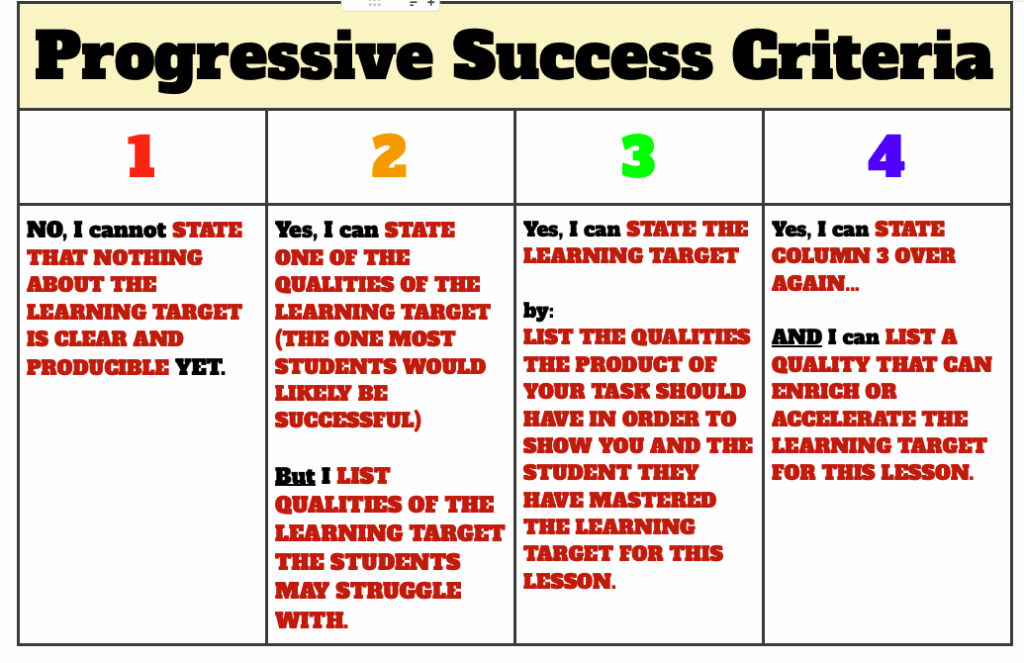
This is where Progressive Success Criteria become so essential. Your examples demonstrate this perfectly. Whether it’s ELA, math, science, or social studies, learners are not judged by a binary yes-or-no. Instead, they are placed along a clear continuum. At Level 1, we acknowledge they are not there, yet. At Level 2, they are attempting pieces, perhaps inconsistently. At Level 3, they are meeting the learning target. And at Level 4, they are deepening, extending, or transferring that learning in meaningful ways.
This is scaffolding that actually scales because it doesn’t assume every learner begins in the same place. It doesn’t punish the learner for not starting at Level 3. It simply says: “Here is the path. Let’s find where you are. Now, let’s talk about what’s next.” And it helps teachers, too. A learner hovering at Level 2 in an argumentative reading task doesn’t need a full re-teach. They need focused support identifying claims and citing textual evidence. A math learner who can plot a vertex but struggles with the direction a function opens? That’s a surgical instructional move. And that precision comes only when success criteria are clearly defined and used consistently.
When your planning starts with progressive criteria, you stop guessing. You start designing with intention. Your tasks align. Your tools match. Your feedback is purposeful. And your learners? They climb.
Let the Learners Lift It
This work is not about letting go of our responsibility. It’s about right-sizing it. We are not abandoning learners. We are equipping them. We are not walking away from our role. We are stepping into the role it was always meant to be: the designer of learning, the architect of opportunity, the facilitator of growth.
Success criteria are not the magic pill. But they are the foundation. They provide clarity, direction, feedback, and progression. They create a classroom where learners know the goal, see the path, and can articulate their place on it. And when that happens, the learning becomes theirs.
So the next time you’re feeling the weight of all thirty learners pulling on your attention, remember this: you were never meant to carry it all. The goal was never to do the learning for them. The goal was to design the learning so they could do more of it themselves. Let’s stop teaching. Let’s start designing. And let’s get back to the heart of the work: helping learners become the ones doing the lifting.