

“What if we walked into this new school year knowing beyond all doubt that our kids will learn at high levels because of OUR design decisions for their learning?”
Not a possibility. Not a goal. A certainty. What if we didn’t just cross our fingers and hope the first day would go well? What if we didn’t wait for the test scores, the PD days, or the pacing guide to tell us what was working? What if the very act of designing learning was done from the assumption that success, real learning, is the natural result of our purposeful decisions?
That’s not just wishful thinking. That’s leadership. That’s clarity. And it’s a mindset shift that doesn’t require more time, more money, or more bandwidth, just more belief in our role as designers and in our learners’ boundless capacity to grow.
Learning by Design, Not by Default
Let’s tell the truth here: we don’t need one more pre-packaged curriculum, one more “essential” standard, or one more assessment platform to “track progress.” We need something much more foundational: a belief that the choices we make as designers are what drive learning. Not the tools. Not the tests. Not the textbooks.
As outlined in Let’s Stop Teaching and Start Designing Learning, traditional teaching is often about transmission. Design, on the other hand, is about transformation. It’s not about what you say, it’s about what learners do. And what they’re able to do because of how you’ve intentionally structured the time, space, tools, and tasks in your learning environment.
This isn’t a vague notion. The research is clear. Hattie’s meta-analyses show that teacher collective efficacy has the highest recorded effect size at 1.57, that’s nearly four times the average yearly impact. Translation? When we believe together that our decisions directly impact learning, we amplify achievement at a level that almost nothing else can touch.
That means this belief can’t stay in your lesson plans. It has to live in your conversations. Your PLCs. Your hallway discussions. Your morning routines. It has to be the reason you teach, not just the method. Belief becomes practice. Practice becomes design, and design becomes results.
Learners Are Not Broken. Our Systems Might Be.
There’s this lie floating around education that some kids just “don’t want to learn.” But that’s not true. What’s true is that many learners have never been invited into a space where learning feels possible, where learning is something designed for them, not delivered to them.
That’s why language matters. You won’t find the word “student” here. Because the word “student” implies someone who is acted upon: someone who receives. A learner, on the other hand, is someone who engages. Who constructs. Who creates meaning out of experience. And that’s what we’re here to develop.
Yet we keep expecting high-level learning in environments that are compliance-driven and teacher-centered. We demand critical thinking from worksheets. Collaboration from silent rows. Perseverance from fill-in-the-blank templates. Then we’re surprised when the work falls flat. What if we flipped it?
When we design learning, truly design for it to happen, we create pathways that allow learners at all readiness levels to engage deeply, move at their pace, and show what they know in ways that are meaningful. This is where feedback (0.72), classroom discussion (0.82), and academic press (1.01) come alive. They’re not add-ons. They’re design choices. And they build equity into the foundation of learning, not as an afterthought but as the default.
Every time we hand a learner a multiple-choice test without scaffolding their thinking process, we communicate, “You’re on your own.” But when we embed visible thinking routines, when we model cognitive strategies, when we design tasks where learners reflect, revise, and refine—we communicate, “You’re capable. Let me help you see how.”
Designers, Not Deliverers: The Real Identity Shift
This is the part that changes everything. Because if we still see ourselves as people who “teach lessons,” we’re still holding on to a model that centers our voice instead of the learner’s thinking. But what if we stopped asking, What do I have to teach this week? and started asking, What do my learners need to do this week in order to grow? That’s the question a designer asks.
Designers don’t open with objectives—they open with outcomes. They don’t start with “coverage”—they start with clarity. They don’t measure success by how much they said, but by how much learners can show. And they don’t hand over learning in packets. They invite learners into it through choice, challenge, and conversation.
This is why the work session you described in your book is such a critical anchor. It’s not a break from teaching. It is the teaching. It’s the space where learners are doing the cognitive heavy lifting, making decisions, taking risks, and owning their progress. It’s also where the teacher finally breathes, not because they’re “off duty” but because they’ve passed the baton.
And when learners are working harder than we are, it means we’ve done the job right. We’ve shifted from the front of the room to the center of the design. We’ve moved from being the expert with answers to the architect of opportunities. And that changes not just the climate of a classroom, but the culture of an entire school.
The Work Is Worth It
So here’s where we land. This work we do. It’s not for the faint of heart. It takes energy to design when everyone around you is still delivering. It takes courage to create when the system celebrates compliance. But it’s the only kind of work that changes lives. And it’s the only kind of work that will keep you coming back year after year with purpose still burning.
This year, what if we didn’t hope they learned? What if we knew they would because we designed for it? And what if we stood in front of our classrooms, our teams, and ourselves with a quiet conviction that says: I’m not just here to teach. I’m here to transform. Let’s go design something unstoppable.
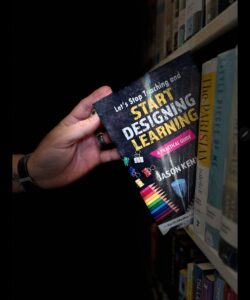
This mindset shift seems so easy but many of us know who lead buildings that it is a effort from the top to the last hired but WE CAN MAKE THAT SHIFT!!! We are “hope dealers” and that hope is in education and a better life for themselves and our future! I would urge anyone who subscribes or sees this to spend time investing in what Jason is sharing and take it to heart!
Our 2 questions to answer daily as leaders: “What did I do today to promote student learning?” and “What did I do today to support teachers?” Those ARE the job!