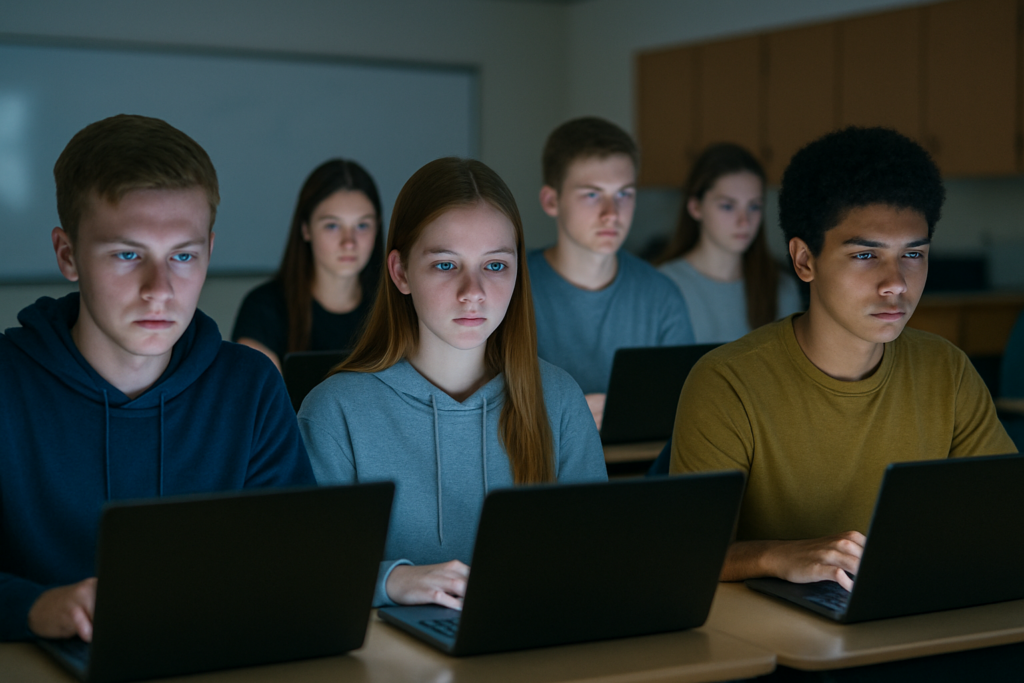
Here’s the scene: seventh period, chairs in neat rows, every kid “on task.” Except the task isn’t learning; it’s tapping, scrolling, chasing the next tab. The room looks productive. It’s quiet. Orderly. But if we pressed pause and asked, “What did you learn? Why is it important? And How do you know you learned it?” we’d probably get a lot of blank screens staring back. In too many classrooms, the glow of screens has replaced the growth of learning. And it’s costing us.
Across large assessment datasets, as daily in-school screen time climbs, achievement falls, steeply at the extreme end. In multiple cycles of PISA, students using computers 6+ hours per school day scored about 65 points lower than peers who didn’t use them at all. That’s roughly a two-letter-grade drop. And the mechanism isn’t a mystery. Digital reading often collapses the spatial scaffolds that help memory stick, pushing learners toward skimming over comprehension.
What Screens Change in the Learning Brain
Learning isn’t a content dump; it’s a construction project with neurons wiring through effort, attention, and retrieval. Our tools either scaffold to support that build or they shake the ladder.
Start with handwriting. In a recent high-density EEG study summarized by Paul Kirschner, handwriting produced widespread, coordinated brain activity, parietal, motor, and language networks syncing in “learning-ready” webs. Typing? Much weaker connectivity. What this means is that the pen asks more of the brain, so the brain remembers more. The practical upshot is plain. When the goal is encoding, summarizing, or reasoning, put a pen in learners’ hands.
Reading shows a similar friction/gain story. Paper gives ideas a place-fixed locations your hippocampus can anchor to. Device scrolling erases those anchors and tempts shallow pass-through. That’s why screen reading so often yields skim-and-snip instead of learn-and-keep. Contemporary syntheses are nuanced. Some find no global difference when moderators are favorable, yet younger readers, longer texts, and inference-heavy tasks still tilt to print.
And how about attention? Devices don’t just host learning, they also host every distraction in the known universe. PISA 2022 reporting shows large shares of learners distracted by their own or others’ device use in class, and those learners perform lower, prompting OECD to urge schools to limit in-class digital distraction. The bottom line is this: cognition favors friction. Use analog tools to build ideas and bring digital in when it does something paper can’t.
Time on Task or Time on Tabs?
A calm room of open laptops looks like learning. But “screen time” ≠ “learning time.” The system-wide pattern is consistent: more screens during core learning, lower scores. PISA trends, TIMSS, and NAEP all echo the same slope down. So what should earn device time? Anchor school technology to three educational purposes: no more, no less. Everything else should be analog by default.
1) Collaboration. When tech multiplies minds—real-time co-writing, structured peer review, debate boards where claims need evidence, it can boost interaction and motivation. Meta-reviews of CSCL point to positive social/engagement effects; achievement gains depend on strong task design and scaffolds. In short, don’t confuse chatting with collaborating. It’s the expectations of roles and rubrics make the difference.
2) Creating. Use devices when learners make products that paper can’t handle as well: multitrack podcasts, simulations, data-rich visuals, publish-ready writing with iterative revision. The cognitive move is transformation, not transcription. If the device only speeds up low-level tasks, it’s probably taxing attention without upgrading learning.
3) Research. Search on screen, study on paper. Teach lateral reading, source vetting, and advanced operators online, then move key sources to printed excerpts or fixed-layout PDFs for the deep-thinking phases (annotate, compare, synthesize). This pairs each medium with what it does best and dodges scroll-induced skimming.
Meanwhile, remember the macro reality: the more time learners spend on screens in school, the further average scores fall, up to a 65-point gap at 6+ hours/day. That’s not feelings or a hunch, that is the global report card talking.
Moves to Shift Away from Excessive Screen Time (Without Losing What Tech Does Well)
Put the learning target, not the device, in the driver’s seat. If the aim is remembering or reasoning, default to paper for reading, annotation, and first-draft thinking. Save devices for the Big Three: Collaboration, Creating, Research.
Make “paper first” the norm for core literacy. Print the article, novel chapter, or problem set. Teach margin notes, one-minute writes, and concept sketches as standard operating procedures. These analog routines build the spatial and sensorimotor scaffolds screens strip away.
Structure device use, don’t just allow it. Move from “open laptops” to device-on/device-off intervals tied to the task. Lids down during instruction, discussion, and formative checks; brief, intentional “on” windows for research or co-drafting. OECD’s guidance is blunt. It begs us to limit in-class digital distraction.
Re-center handwriting where it matters. Require handwritten note captures for short lectures, problem-solving journals, and paper exit tickets. Pair with quick digitize-and-archive workflows so accessibility isn’t lost. (EEG: handwriting engages learning-relevant networks far more than typing.)
Teach “attention as a skill.” What does that look like in visible norms? Full-screen apps only, notifications off, seating that makes off-task toggling obvious, and explicit why/how lessons on attention. Treat it like lab safety, practiced and non-negotiable. (PISA reports widespread device-driven distraction tied to lower performance.)
Pilot, measure, then scale. Before buying shiny platforms, run small local trials against your current analog alternative. Track learning outcomes, not just completion rates. If a tool doesn’t beat paper or whiteboards under your conditions, don’t scale it.
Less Scrolling, More Schooling
This isn’t a crusade against devices. It’s a defense of cognition. We can keep surrendering prime learning minutes to tools that fragment attention and flatten memory, or we can restore classrooms as places of deep focus, sustained effort, and real connection. Choose the latter. Use tech on purpose, for Collaboration, Creating, and Research, and let paper, pens, and people do the heavy lifting of learning.