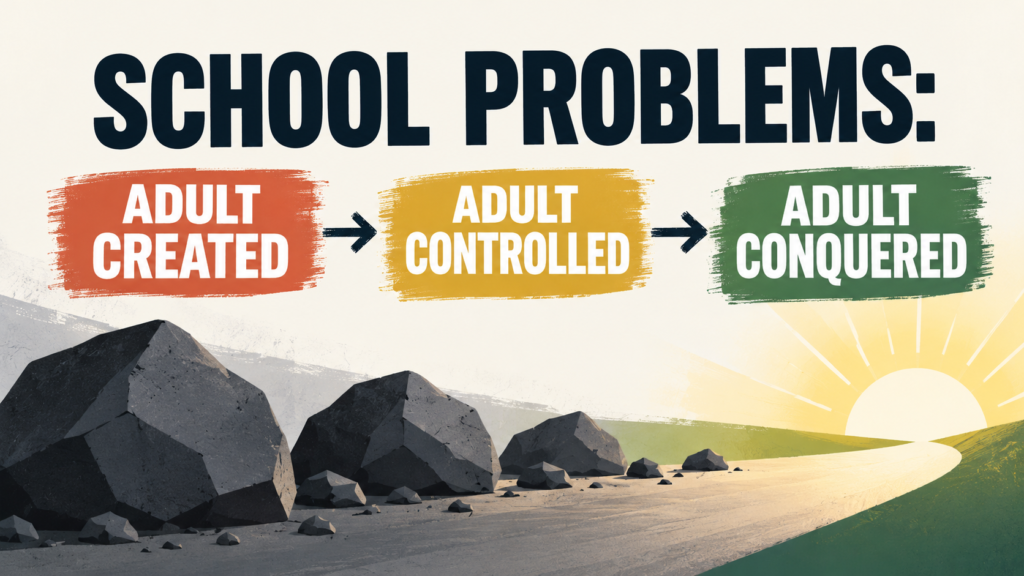
Adult Created. Adult Controlled. Adult Conquered.
Here’s a statement that’ll probably make some educators uncomfortable. In fact, some of you may disagree with me before you even finish reading it. After spending most of my adult life working in schools, I have come to believe something that we need to acknowledge if we’re ever going to make meaningful improvements in education.
100% of the problems, obstacles, and barriers in our schools are adult created and adult controlled.
Now, before you start making a list of everything that happens outside the school walls that impacts learning, let me save you some time. I know those things exist. Poverty is real. Trauma is real. Families face challenges that many of us cannot begin to understand. Learners come to us with different experiences, backgrounds, abilities, and needs. Lawmakers and legislation apply mandates. District leaders have initiatives. The list goes on.
We don’t get to control any of those circumstances, and I would never pretend otherwise. But we absolutely control what happens when those learners walk through our doors and into our rooms, and THAT is where I want us to focus. And the good news is this: those same problems, obstacles, and barriers can also be ADULT CONQUERED.
We Might Create Some of Our Biggest Obstacles
Think about the things we spend so much time discussing in education. Low achievement. Poor engagement. Behavior problems. Learners who are behind. Lack of motivation. Too much testing. Not enough time. We have meetings about these things, develop plans to address them, purchase programs to fix them, and sometimes even create committees to study why our previous plans didn’t work. If you’ve been in education long enough, you know we are exceptionally talented at creating a meeting to discuss the need for another meeting. But how often do we examine the decisions we adults have made that may be contributing to the very problems we are trying to solve?
We decide how time is used in our schools. We decide what learning opportunities look like. We determine which learners get access to challenging work and which ones spend their days completing remedial tasks. We establish expectations for behavior, design schedules, select instructional resources, and determine what counts as evidence of learning. We even decide how we respond when learners struggle. These are adult decisions. And those decisions have consequences for learning.
Consider the learner who has struggled with reading for years. We may spend a tremendous amount of time discussing that learner’s deficits, previous test scores, attendance, family circumstances, and everything else that might explain the struggle. Those things may help us understand the situation, but eventually we have to examine what we are actually designing for that learner each day. Are we providing the instruction, practice, feedback, and opportunities that will move learning forward? Or have we become so accustomed to describing the problem that we have stopped questioning our response to it? I’ve been guilty of this myself. It’s much easier to explain why something isn’t working than to examine whether something I’m doing needs to change.
When We Blame What We Can’t Control, We Give Up What We Can
There is a dangerous comfort in believing the biggest obstacles to learning exist somewhere outside our influence. If we believe that learners cannot succeed because of their home lives, their previous teachers, their motivation, or their abilities, we’ve already placed limits on what we believe is possible. We’ve place limits on their learning and limits on our ability to provide it. Once we establish those limits in our minds, they have a way of showing up in the opportunities we provide.
I said this in my last post, and I will continue saying it. Kids don’t need heroes. They need believers. But that believe also requires action on our part. Believing in learners means accepting responsibility for creating the conditions in which they can succeed. It means recognizing that the circumstances of a learner’s life may explain where learning begins, but they should never determine where we believe learning can go. That belief has to influence our instructional choices, expectations, and responses every single day.
This responsibility extends well beyond the classroom. School leaders make decisions that either support or interfere with effective learning design. District leaders establish priorities that either give teachers the time, resources, and support to improve their practice or bury them beneath another collection of initiatives. We all have a hand in creating the educational experience our learners receive. If we’re willing to acknowledge that, we can begin doing something about it.
Designing Learning Is How We Conquer What We Control
This is where we have an incredible opportunity to change our schools. We have spent decades trying to improve education by adding more things to it. More programs. More interventions. More assessments. More initiatives. And while some of these things are valuable, we sometimes overlook the one experience every learner has in common: Tier 1 instruction. What if we made the intentional design of learning our first priority?
What if every instructional decision began with a clear understanding of what we wanted learners to know, understand, and be able to do? What if the tasks we designed actually required learners to think, apply, explain, evaluate, and demonstrate that learning? What if we gathered evidence throughout the learning process and used what we discovered to determine what happened next? Think about how many of our familiar problems could be addressed if we made those practices consistent in every classroom.
Learner engagement improves when the work is meaningful, appropriately challenging, and requires active participation. Clarity improves when learners understand what they are learning and what success looks like. Struggling learners receive better support when teachers identify specific gaps in understanding and respond with purposeful scaffolding and feedback. Even some of our behavior concerns become more manageable when learners experience classrooms where expectations are clear, relationships are strong, and the work provides a genuine reason to participate.
Will designing learning eliminate every challenge schools face? Of course not. But it gives us a way to respond to challenges through deliberate choices we can examine, evaluate, and improve. We can stop relying so heavily on explanations for why learning isn’t happening and begin looking closely at the learning opportunities we are creating. And that requires us adults to change some things we have grown comfortable doing.
The Responsibility Belongs to All of Us
I don’t believe most educators wake up in the morning intending to create barriers for learners. Just like most of our kids don’t wake up with the mission to do everything they can not to learn and to disrupt class. It is quite the opposite. Most of the educators I know work tremendously hard (too hard, in fact) and care deeply about the children in their schools and classrooms. But hard work and good intentions don’t automatically produce learning. We have to be willing to look at the impact of our decisions, especially when that evidence challenges what we believe about our own effectiveness.
This means teachers must examine the learning their lessons actually produce. Leaders must examine whether their expectations and decisions support that work. Districts must look at the systems they have created and determine whether those systems make learning more likely or simply make the adults feel more organized. And when something isn’t working, we have to change it.
There is tremendous power in that realization. If we can create a schedule that limits learning opportunities, we can create one that expands them. If we can develop practices that unintentionally lower expectations for certain learners, we can redesign those practices. If we can spend hours developing intervention plans for learners who are struggling, surely we can devote that same attention to strengthening the daily learning experiences every learner receives.
Something else I want us to consider. Think about the school building where you work. Within those walls, there are probably centuries of combined educational experience and multiple millions of dollars invested in college degrees, advanced degrees, certifications, and professional learning. Think about that for a minute. We have assembled buildings full of educated, experienced professionals who have spent their careers working with learners. Yet how often do we look outside those same buildings for someone or something to come fix our problems? We purchase another program, hire another consultant, or wait for the next initiative to arrive with all the answers. I would argue that many of the answers we’re searching for are already walking the halls of our schools every single day. We just have to create the conditions for those adults to work together, share what they know, examine evidence of learning, and put that collective expertise to work.
I want us to think about the conversations we have in our schools. The next time we identify a problem, an obstacle, or a barrier to learning, let’s examine the adult decisions connected to it. Let’s look at what we have designed, what evidence we have of its impact, and what we are prepared to change. We may discover that some of the solutions we’ve been searching for have been within our influence all along. We can’t control every circumstance a learner brings into our schools. But we can control the learning experiences we design in response to those circumstances. We can control our expectations, our choices, and our willingness to change when the evidence tells us something isn’t working.
Adult created. Adult controlled. Adult conquered.
I believe we have far more power to improve our schools than we give ourselves credit for. But realizing that potential requires us to accept the responsibility that comes with it. (Remember the Spiderman quote about power and responsibility?) After all, if we adults have the power to create barriers to learning, shouldn’t we be just as determined to conquer them?