For the last few years, much of the conversation about AI in classrooms has started with the same question: How do we keep learners from using AI to do their work? I’m beginning to think there is a more useful question we should be asking. Why can AI do so much of the work we have traditionally asked learners to produce as evidence of learning?
Think about some of the products that have become staples of classrooms. We ask learners to write summaries, create presentations, answer questions, write essays, make posters, and research topics. For years, we have looked at those finished products and used them as evidence that learning occurred. Sometimes they provided exactly that evidence. Other times, they simply showed us that a learner could produce what we asked for.
AI has complicated that assumption because it can now create many of those same products in seconds. Maybe the opportunity in front of us is bigger than figuring out how to prevent that from happening. Maybe we can use those products differently.
Learners still need knowledge. They need opportunities to retrieve, practice, summarize, explain, and build fluency because deeper thinking requires something worth thinking about. AI has not changed how learning works. It has changed what we can reasonably infer from a finished product.
AI Exposed the Completion Problem
A polished essay once gave us at least some reason to believe a learner had wrestled with the ideas inside it. A presentation suggested the learner had researched the topic, selected information, organized it, and decided how to communicate it. A written response suggested the learner had read the material and developed an answer. Those assumptions are much harder to make now.
AI can produce the essay, presentation, summary, explanation, or response. That does not mean those products suddenly have no place in learning. In fact, they may give us an entirely new opportunity. Instead of always asking learners to create the first version of the product, we can sometimes put the product in front of them and ask them to show us what they can do with it. That moves the evidence of learning away from simply possessing a finished product and toward the thinking learners demonstrate around it.
Give Learners Something Worth Thinking About
Imagine giving learners an AI generated explanation of the causes of the Civil War. The assignment does not end with reading it. Learners analyze the explanation, identify what it gets right, determine what it oversimplifies, corroborate its claims with primary and secondary sources, and revise the explanation based on the evidence they uncover.
In an English classroom, AI might generate an interpretation of a text. Learners evaluate the interpretation against the text, identify weaknesses in the reasoning, determine whether the evidence actually supports the claims, and develop a stronger interpretation.
Mathematics offers the same opportunity. Give learners an AI generated solution to a problem and ask them to analyze the reasoning. Where is it efficient? Where might another strategy work better? Is there an error hidden somewhere in the process? Would the strategy transfer to a different problem, and how do they know? The product has not disappeared. Its role in the learning experience has changed.
This is also where the research around deeper thinking fits naturally. MetaX currently reports an effect size of 0.79 for critical thinking, which includes analysis, inference, evaluation, interpretation, and reasoning. Transfer strategies are reported at 0.89. Those numbers reinforce the kind of shift AI is inviting us to make. Once a product is available, the learning opportunity can move toward what learners can analyze, evaluate, improve, defend, and ultimately transfer from it. AI can actually give us more products to think with. Our design decisions determine what learners are asked to do with them.
Design for Evidence of Thinking
This shift also requires clarity about what we are trying to learn from the learner. If the target is simply “create a presentation,” then AI creates a significant problem because the product itself has become the goal. If the target involves analyzing competing explanations, evaluating evidence, defending a conclusion, or applying a concept, the product becomes a vehicle through which learners demonstrate that learning.
That distinction connects directly to teacher clarity. MetaX currently reports teacher clarity at an effect size of 0.85 and success criteria at 0.64. As tasks become more cognitively demanding, learners need to understand what they are learning and what quality thinking looks like. The target identifies the learning, the task creates the opportunity to demonstrate it, and the success criteria help learners evaluate the quality of their thinking. This gives us a useful question when designing learning in an AI rich world: What will learners have to do with this product that gives me evidence of their thinking?
That question opens up possibilities. Learners can critique an AI generated essay and then defend their revisions. They can compare two AI generated explanations and determine which is more accurate. They can fact check a response and document the evidence they used. They can improve a weak solution, challenge an assumption, identify bias, explain an error, or transfer an idea into a completely different context. Now the evidence is found in what learners do with the product.
Maybe AI Did Us a Favor
For years, we often created the product and the thinking at the same time. We asked learners to write the essay because we believed writing the essay would reveal their understanding. We asked for the presentation because we believed creating it would show us what they had learned. AI has separated those two things. It can give us the product without giving us any assurance that the learner did the thinking behind it. That forces us to become much more intentional about where we look for evidence of learning.
The essay can stay. The presentation can stay. The summary, solution, explanation, and research product can stay too. Sometimes learners should create them themselves. Other times, AI can put those products on the table and allow us to begin the learning somewhere different. Then we can ask learners to tear them apart, check them, challenge them, improve them, defend them, and use what they know to decide whether they are any good.
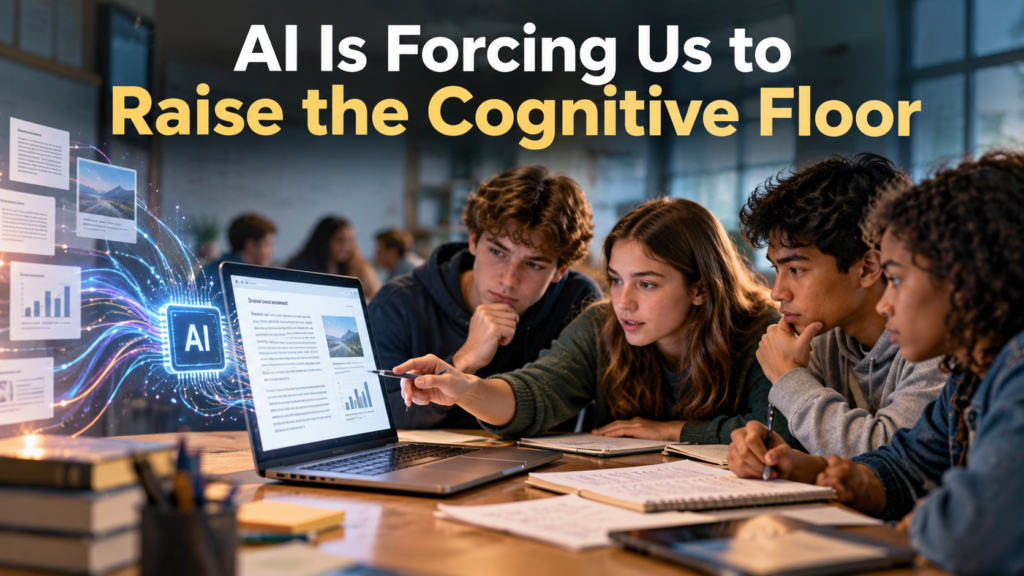
Maybe AI is not lowering the bar for learning. Maybe it is giving us a reason to raise the cognitive floor.