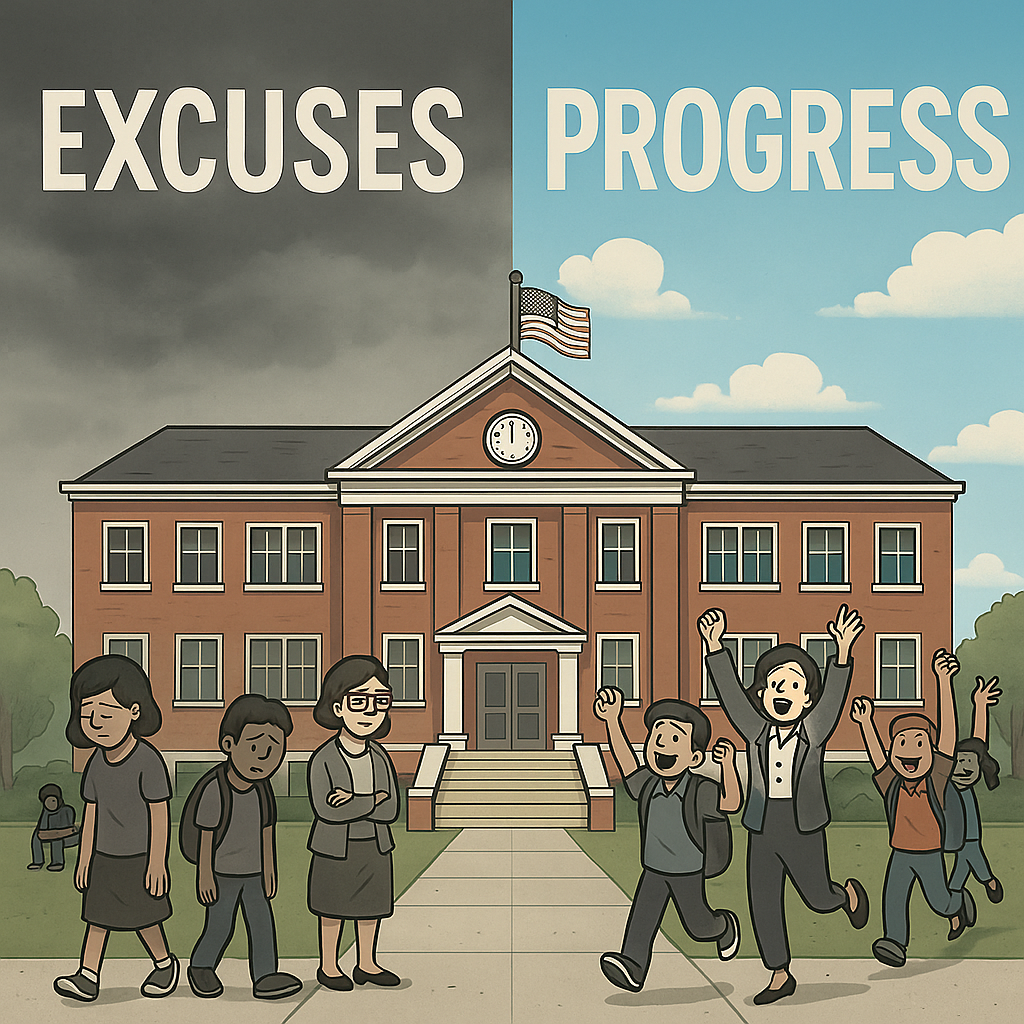
Here’s the uncomfortable truth: in schools, we’re always doing one of two things. We’re making excuses for why learning isn’t happening at the level we want. Or we’re making progress to ensure it does. It can’t be both. Excuses soothe. Progress stings a little, then gets better. The difference isn’t the kids, the calendar, or the curriculum. The difference is design. What we choose to build into the learning day on purpose. If that sounds blunt, good. Kids don’t have time for our soft landings. Neither do we.
Teachers: From Deficit to Design
Let’s name the three greatest hits and flip them.
Excuse 1: “These kids aren’t motivated.” We really like to point at the fault being inside the kids instead of inside of the task we are giving them. We CAN design engaging and challenging tasks for learners that have built in success to motivate them. We adults don’t self-motivate. We rely on outside effects to keep us going, so why do we expect it from our kids?
Design move: Make success visible and inevitable. Motivation follows evidence of learning. Break the standard into bite-sized learning targets with plain-language success criteria: “I can analyze two pieces of evidence and explain which is stronger.” Then engineer early wins with worked examples, guided practice, and checks-for-understanding every 7–10 minutes. Fast feedback. Short cycles. Let learners see themselves getting it. Motivation shows up when progress does. Combine this with providing tasks that are actually interesting (not a worksheet) then you will see a change in the kids because we’ve changed our practice.
Excuse 2: “The pacing and standards move too fast.” But we have to cover the standards! Here’s the truth. There is not enough time to do that. So, we stop talking about coverage and we shift the conversation to mastery. Take the standards (which ARE your curriculum by the way) and break them down into targets. Now, take those targets and with your team decide, “These are the ones they will not leave us without!”
Design move: Teach the essentials at the right grain size. Standards aren’t paragraphs to cover; they’re skills to master. Prioritize the must-learns. Unpack them into knowledge, skills, and reasoning. Sequence them so each task is a rung on the ladder, not a new ladder. Use retrieval practice to keep prior learning alive while you move forward—two quick prompts at the start of class, one exit check at the end. Coverage says, “We touched it.” Clarity says, “They own it.” It would be nice for them to know all the standards, but we must focus on what they NEED to know before leaving us. That’s how we catch up.
Excuse 3: “I spend more time managing behavior than teaching.” I’ve looked around the room during faculty meetings or professional development. The adults in the room display the same behaviors they crawled all over the kids for just an hour before. Why? Lack of engagement. Our energies tend to drift away from what we SHOULD be doing to what we want to do. So, design for it.
Design move: Preload the lesson with structure and purpose so engagement does the heavy lifting. Routines reduce friction. Relevance reduces noise. Intentional Give every learner a job, the reader, checker, summarizer, challenger. Build in movement: stand, pair, swap, write. Keep directions on screen as a checklist. Engagement cures a multitude of classroom ills. When tasks are clear and appropriately challenging, the room calms because learners are busy doing the thing school promised, learning.
Leaders: From Lament to Leverage
Leaders give different versions of the same song. Let’s rewrite it.
Excuse 1: “Some teachers just aren’t implementing with fidelity.” Leaders often fear giving out instructional boundaries. But the fact is that collective teacher efficacy is a set of collective commitments to the learning in the building. Leaders have to lead this, inspect what you expect and rally everyone around it.
Design move: Let’s shift fidelity to what we really mean: integrity. Build the conditions where instructional integrity is the easy choice. Clarity + modeling + feedback. Make what good learning looks like concrete: a short instructional playbook with 6–8 non-negotiables (learning targets, success criteria, checks-for-understanding, modeling, guided practice, feedback, learner talk time, closure). Then model those moves in faculty meetings and professional learning. Walk classrooms for evidence of learning, not gotchas. Coach with tight, bite-size goals and rapid cycles. Integrity grows where coherence lives in the shared belief and commitment by all in the building.
Excuse 2: “We don’t have enough resources, time, or staff.” Money’s tight. I get it. There’s SO many free things that AI can build for us now. Time? We can’t make more, but we can move things around. If we put something on teachers to implement, let’s commit to de-implementing something as well.
Design move: Aim what you do have at the highest leverage. Time is your biggest budget line, reallocate it. Protect daily planning windows for grade-level teams. Use the master schedule to put intervention inside the day, not outside of it. Deploy specialists for push-in modeling and small-group acceleration tied to classroom targets (not a parallel curriculum). Stop funding initiatives that don’t touch Tier 1. Working on the right work of learning gets ALL of our time back. Depth beats breadth. Always.
Excuse 3: “Our kids face so many challenges at home.” When we blame the demographics we are saying we don’t have the power to make a difference or we just don’t want to put forth the effort. We’ve got the kids when we’ve got them. We have to make that matter.
Design move: Double down on what we control inside our walls. That starts with strong Tier 1 for every learner, then timely Tier 2 that’s specific, brief, and measured. Warm, but strict routines. Belonging rituals that take five minutes, not fifty. Data conversations that focus on designing the next task, not labeling kids. When we consistently design for clarity, practice, and feedback, kids stop guessing and start knowing. Success criteria they can see. Short, deliberate reps with immediate checks. Micro-reteaches in the moment, not next week. Data that names the next task, not the child. We can’t control bedtimes or bandwidth, but we can control bell-to-bell. That’s how classrooms become the most stable place in some kids’ day, and how zip code stops predicting outcome inside our walls
The Hope Section: We Already Hired the Answer
Let’s say the quiet part out loud: the answers are already in the building. We have millions of dollars in degrees under one roof. Centuries of combined experience. People who have seen wave after wave of “new” and kept the best parts. The raw material is not the problem. Our alignment is.
Teachers, you are designers. You don’t wait for a perfect class to show up so great teaching can finally begin. You design so great learning can happen with the class you actually have, on a rainy Tuesday in October, after a pep rally, with a fire drill in the middle. You write targets in kid-language. You model thinking like it’s a magic trick, then hand the cards to learners and let them do it. You build in practice on purpose. You give feedback that changes tomorrow, not just the gradebook. You iterate. That’s the work. That’s the joy.
Leaders, don’t be shy about the thing that matters most. You are the instructional leader. Say it. Own it. Learning is why the building exists, so lead the learning. Be visible in classrooms for the right reasons. Teach a little. Coach a lot. Protect the minutes where teachers plan together and look at learners’ evidence. Strip away the noise so the signal (clarity, practice, feedback) gets louder. When adults experience what great design feels like in professional learning, they’ll replicate it for kids.
This is not a call to heroics. It’s a call to habits. Small, durable design choices that make excuses feel silly because progress is in the room, right now, in learner work we can hold in our hands.
If you want a place to start, try this five-step “tomorrow plan”:
- Name one essential target for the day.
- Draft three success criteria in simple language.
- Plan a 12-minute learning burst: model → guided try → quick check.
- Decide the feedback you’ll give when learners are almost there. Script the sentence stem.
- End with a one-question exit check tied to the target. Use it to plan the first ten minutes of tomorrow.
That’s it. Not a program. A posture. Not a slogan. A sequence We can spend our energy defending why learning isn’t happening yet. Or we can design so learning happens now. Excuses or progress. Pick one. Then build like you mean it.