Let’s just say it out loud.
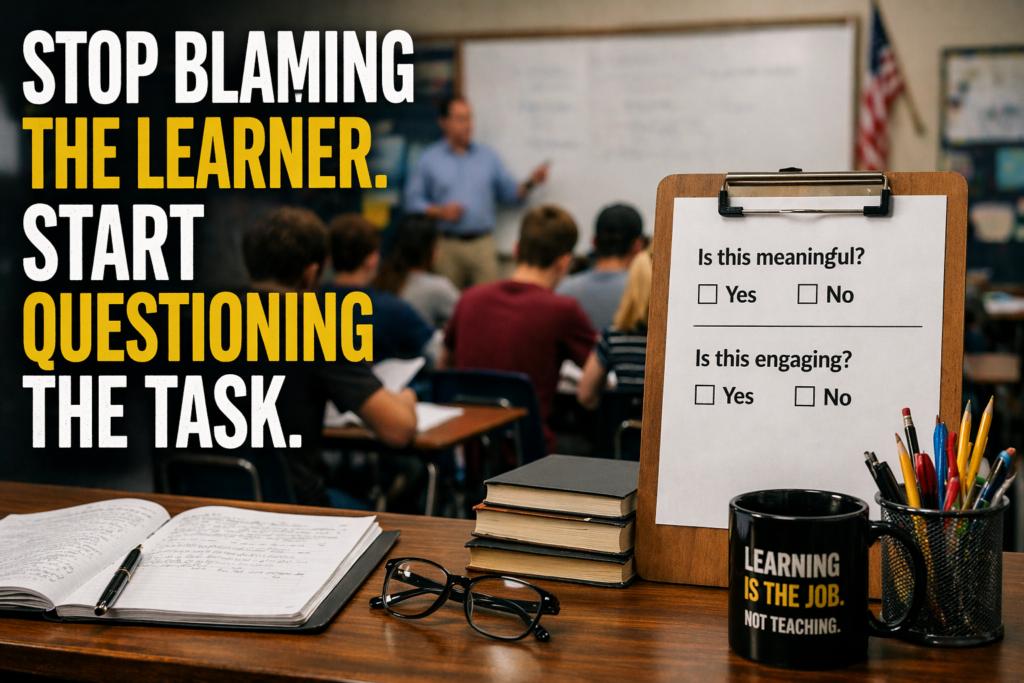
Maybe it’s not that learners don’t want to work. Maybe it’s that they don’t want to do the work we keep handing them. That’s a different conversation, and an uncomfortable one, because it turns the mirror around on us. For years we’ve had a convenient explanation ready to go. Lack of motivation. Lack of grit. Lack of responsibility. It’s easy, and it lets us off the hook. But what if the issue isn’t the learner at all? What if it’s the task?
Because if we’re honest, we’ve all seen it. A room full of compliant learners who are quiet, working, finishing, and turning things in, yet there is little real evidence that learning actually happened. That’s where the question has to shift. Not what’s wrong with them, but what are we asking them to do.
When Work Isn’t Worth Doing
We have built entire systems around completion. Finish the assignment, turn it in, get the grade, and move on. Somewhere in that cycle, learning got replaced by work, and we stopped noticing the difference. Worksheets, question sets, read and respond, and even digital versions of the same thing all create the appearance of productivity. They feel structured and controlled, but when we step back and ask what kind of thinking is actually required, the answer is often very little.
Learners know the difference. They can tell when a task matters and when it simply fills time. When the work lacks relevance, challenge, or purpose, motivation isn’t the problem. The task is.
Traditional teaching leans heavily on passive experiences where learners receive information and then complete something tied to it. That cycle repeats itself day after day, and while it may produce compliance, it does not guarantee learning. When we continue to rely on that model, we shouldn’t be surprised when engagement drops. It’s not that learners can’t engage, it’s that they won’t for work that doesn’t require them to think, decide, create, or solve.
Engagement Isn’t a Personality Trait
We tend to talk about engagement as if it’s something learners either bring with them or don’t. In reality, engagement is something we design for through the experiences we create in the classroom. In too many classrooms, one person is doing most of the work. The teacher is talking, explaining, modeling, and performing, while being fully engaged in the lesson. The rest of the room watches, or at least appears to.
We convince ourselves that eye contact, head nods, and completed assignments are signs of engagement, but compliance is not evidence of thinking. Many learners have mastered the ability to “do school” without ever fully investing in learning. Real engagement demands something different. It requires learners to wrestle with ideas, make decisions, collaborate with others, revise their thinking, and defend their reasoning. That kind of engagement doesn’t happen by accident. It happens by design.
Research reinforces this shift. Teacher clarity carries an effect size of approximately 0.85, meaning when learners understand what they are learning, why it matters, and how they know they’ve learned it, achievement accelerates significantly. That clarity isn’t about delivering better explanations, it’s about designing better tasks that make learning visible.
What This Looks Like in Practice
If we are serious about changing engagement, we have to start with what we ask learners to do every single day. Not the lesson itself, but the task at the center of it. Strong tasks require thinking, not just recall or repetition. If a learner can complete the work without making a decision or applying understanding, then the task is not doing enough.
Tasks must also make learning visible. They should produce something that clearly shows whether the learning target was met. If we can’t point to evidence of learning, neither can the learner. Purpose has to be clear from the beginning. Learners should be able to answer what they are learning, why it matters, and how they will know they have been successful. When those answers are present, focus and motivation follow.
Ownership also plays a critical role. When tasks include opportunities for collaboration, choice, and voice, learners are more likely to invest in the work. These are not extras to be added if time allows. They are essential components of effective design. And then comes the hardest part. Reflection. We have to look honestly at the tasks we are assigning and ask whether they are truly worth doing. If we wouldn’t want to do them ourselves, it’s hard to expect learners to engage deeply with them.
The Shift We Keep Avoiding
We have spent years refining how we deliver content, but far less time rethinking the experiences we create for learning. Until that changes, we will continue to circle the same challenges, blaming motivation and pushing compliance while engagement remains out of reach.
Learning is the job. Not teaching, not assigning, not covering content, but learning itself. So when engagement is low, the solution isn’t a new program or initiative. It starts with a better question. What are we asking learners to do, and is it worth doing?