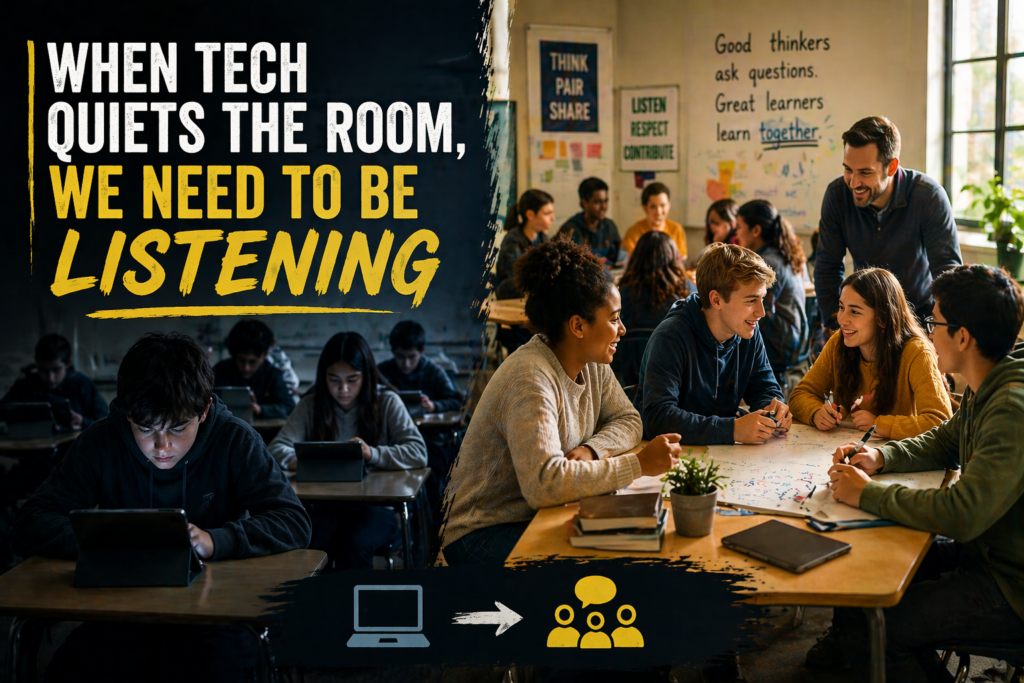
Walk into enough classrooms and you can feel it before anyone says a word. Heads down. Screens up. Silence everywhere. And because the room is quiet, because everyone looks busy, because the task is moving, we convince ourselves that learning must be happening.
But quiet is not proof. Busy is not proof. A screen full of completed clicks is not proof. I want to say this as plainly as I can. If the technology being used in the classroom is reducing the interaction and communication between the people in that room, then we are probably using it wrong. Full stop.
That is not anti tech. That is pro learning. And more and more, the larger conversation is finally catching up to that. Just this week, Los Angeles Unified School District moved to limit learner screen time across the district. In January, the Senate Commerce Committee held a hearing focused on the impact of technology on America’s youth. This year, 16 states have legislation being introduced to place limits on technology in the classroom. This is no longer some side conversation for a few frustrated teachers and leaders. People are starting to ask out loud what many of us have been feeling in classrooms for a while now. Something is off.
The Problem Is Not the Device. It Is What the Device Is Replacing
Too much of what gets called innovation right now is not really innovation at all. It is the same old compliance game with a shinier cover. The worksheet became digital. The packet became digital. The isolation became digital. The room still runs on passivity. It just has better graphics now. And the loss is not only academic. It is human.
Because learning was never meant to be a room full of people having separate relationships with screens. Learning is social. It is verbal. It is visible. Learners need to hear each other think. They need to explain, question, revise, defend, and build understanding together. They need teachers moving through the room listening for misconceptions, pressing for clarity, and lifting the level of thinking. When the device starts replacing those things instead of supporting them, we have crossed a line.
That concern was all over the Senate hearing in January. In his testimony, neuroscientist Jared Cooney Horvath argued that cognitive development across much of the developed world has stalled and in many areas reversed, naming literacy, numeracy, attention, and higher order reasoning. He also argued that digital platforms are built to capture attention, fragment focus, and train habits that work against sustained learning. At the same hearing, senators and witnesses pushed concerns about addictive design, AI companions, and the way these tools can interfere with real human relationships and thinking.
That last part matters to me as much as anything. When a learner begins spending more time responding to a device than to another human being, we should not be shocked when communication weakens. When a room is built around independent screen time, we should not be shocked when collaboration weakens. When tools are designed to hold attention for themselves, we should not be shocked when the talk in the room starts to disappear.
The Pushback Is Already Happening
This is not just a local feeling about tech in the classroom. It is getting harder to ignore globally. Norway is a clear example. In March, the Norwegian government announced major changes for the youngest learners, including rules that schools must be especially cautious with screen use for grades 1 through 4 beginning August 1. The same announcement tied that move to stronger emphasis on reading, writing, arithmetic, play, movement, and oral language, and even raised the question of whether digital skills should still sit beside those other foundational skills in quite the same way. This is the same country that gave every single child an iPad when they turned 5 years old. That is a serious shift.
Sweden has been moving in a similar direction. The Swedish government has pushed more reading time and less screen time, argued that digital learning aids should only be introduced when they help rather than hinder learning, and said schools are expected to become mobile free nationwide before the end of 2026. Sweden has also pushed for more physical books, stronger school libraries, and more analog learning in the early years. Again, that is not anti tech. That is a system stepping back and asking whether it handed too much of the day over to screens. And honestly, none of this should surprise us.
If learners are distracted, disconnected, and increasingly dependent on prompts, of course systems are going to start pulling back. If reading and concentration are getting weaker while device use keeps climbing, of course leaders are going to start asking harder questions. If the room grows quieter but the learning does not grow deeper, then the technology is not helping the one thing we are here to produce. Learning.
What Better Looks Like
So what does using tech right actually look like in a classroom? It looks like the device serving the learning design, not replacing it.
In an elementary classroom, that may mean the teacher uses a tablet or screen for a very short burst to model letter sound mapping or show a picture sequence for a read aloud. Then the devices fade back and the room comes alive. Learners turn knee to knee and retell. They build words with tiles. They record themselves explaining how they solved a problem, then play it back for a partner. Maybe one center uses a device to listen to a text or capture oral reading while another center has learners sorting, drawing, building, and talking. The technology helps, but the communication stays at the center.
In a middle school classroom, maybe the tech delivers the Guided Information, Skills, and Tools quickly. A science teacher shows a short simulation of erosion, then table groups have to predict, test, and argue what they noticed. A social studies teacher uses a shared document so groups can collect evidence from sources together, but then each group has to stand up, defend its claim, and respond to questions from peers. An English teacher lets learners annotate a text digitally, but the real work happens when they sit in a circle and use those notes to challenge each other’s thinking out loud. The screen starts the work. It does not become the work.
In a high school classroom, it may look even more deliberate. A math teacher uses graphing technology so learners can see patterns quickly, but then puts the devices down and has teams explain on whiteboards why the pattern works. A history teacher asks AI to generate possible counterclaims to an argument, then groups have to evaluate those counterclaims, find the weak reasoning, and strengthen the original position with better evidence. A CTAE teacher might use digital design software to create a prototype, but then learners have to pitch it, critique one another’s choices, and revise based on feedback from the room. In each case, the technology helps make thinking visible, but it never replaces the need to communicate.
That is the line for me. If the technology can do something faster, fine. If it can make access easier, fine. If it can help learners draft, model, simulate, capture, or revise, great. But class time is too precious to spend it on things learners could do alone in silence for forty minutes. The best use of class time is still the irreplaceable stuff. The discussion. The confusion. The clarification. The collaboration. The peer feedback. The live coaching from the teacher. The moments when one learner says, “Wait, I don’t see it that way,” and another has to rethink everything.
Leaders, this matters for us too. When we walk rooms, we cannot just ask whether technology is present. We have to ask what it is doing to the human exchange in the room. Is it increasing the talk or decreasing it? Is it making thinking more visible or more hidden? Is it pulling learners toward one another or pushing them into their own digital corners? Those are better questions than, “Are they using a device today?”
So What Now?
We did not bring technology into schools so classrooms could become quieter, colder, and more isolated. We brought it in because we believed it could help learners learn. And it can. But only when it serves the work learning has always required. Human interaction. Human feedback. Human struggle. Human language. Human connection.
So let’s stop being overly impressed by silent rooms full of glowing screens. Let’s stop confusing digital compliance with visible learning. Let’s stop handing over the best minutes of class to tools that reduce the need for people to talk, think, and work together. And let’s commit to this instead: Technology that makes the room more alive. Technology that gives learners more to say. Technology that strengthens relationships instead of replacing them. Because learning is still the job. And when tech quiets the room, we should all get a little nervous.