My Reflections on the First Two Episodes of Sold a Story, Season 2
I just finished listening to the first two episodes of Season 2 of Sold a Story, and I wanted to share some thoughts. If you listened to the first season, you know how much it challenged what was believed about reading instruction. This season is taking on something much bigger: teaching itself. And from what I’ve heard so far, I think every educator needs to pay attention.
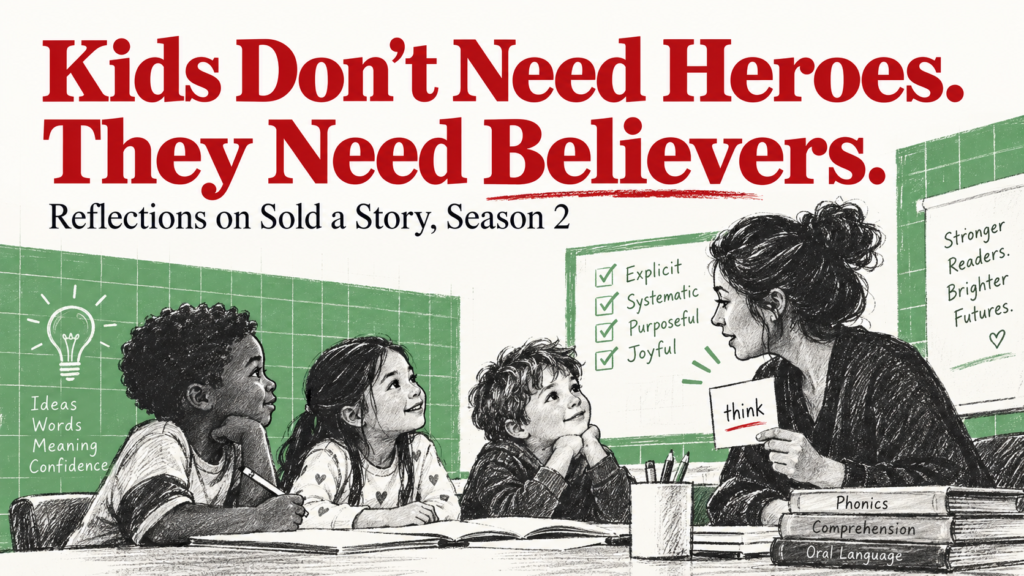
What caught my attention almost immediately was where the story began. It started with belief. If you’ve read much of what I’ve written or heard me speak, you know that is what I lead with: belief. The truth is this: kids don’t need heroes, they need believers. And listening to the story of Zig Engelmann and his work with preschoolers in the 1960s reminded me just how powerful that belief can be when we actually do something about it.
It All Starts With What We Believe
In the first episode, we hear preschoolers doing mathematics that most would consider well beyond their years. These were children whose backgrounds and circumstances had already caused adults to make assumptions about what they could accomplish. Yet there they were, solving problems and demonstrating understanding that challenged those assumptions. Here’s what I kept thinking as I listened. How many times do we allow what we know about a learner to limit what we believe that learner can accomplish?
Age, race, family, address, economic circumstances, past performance, and a hundred other factors can influence a child’s experience. We know that. But when those factors become the foundation for what we expect from learners, we’ve already compromised the learning before it begins.
We’ve all heard the statements. “These kids can’t do that.” “These kids won’t do the work.” “You don’t understand the kids we have.” I’ve written about these statements before because they reveal something about the adults making them. We have to believe every learner is capable of learning at high levels. Otherwise, everything we design and deliver is already diluted by what we believe they cannot accomplish.
Another idea from the podcast hit home. When a learner makes a mistake or struggles to understand, our first instinct should be to examine what the adult has done. What did we explain? How did we model it? What did we assume they already knew? Where might our design have caused confusion?
That’s a difficult responsibility to accept, but learning is OUR job. When we place the responsibility entirely on the learner, we surrender our power to do anything about it.
Before They Could Read, They Were Learning Language
One of the most fascinating parts of the second episode was the preschool’s commitment to language instruction. These children received 20 minutes of intentional language instruction each day, alongside reading and mathematics. Much of that instruction involved oral communication, understanding words, and developing concepts.
The teachers would show learners an object, identify it, and then ask questions about what it was and what it wasn’t. A cup was a cup, but was it a spoon? It sounds ridiculously simple to those of us who already understand these concepts. For a young learner, however, these experiences help develop the language and thinking necessary for understanding increasingly complex ideas.
This made me think about something happening in our homes and communities today. I don’t think we’re talking enough to our youngest children. Too often, when we need to occupy a child, we hand them a device. There are plenty of conversations we could have about what excessive screen time may take away from children, but I want to focus on language.
Think about a trip to the grocery store. Instead of immediately handing a child a device, talk about what you’re seeing. Point out the fruits and vegetables. Discuss their names, colors, shapes, uses, similarities, and differences. Ask questions. Let the child ask questions. Explain words they’ve never heard before.
These conversations provide opportunities to build vocabulary, knowledge, and connections between concepts. The more meaningful connections we help learners develop, the more they have available when encountering something new. We need to talk WITH our children, and we need to do a lot more of it.
Sometimes We Have to Forget What We Know
Another lesson from Engelmann’s work was the importance of thinking like a beginner. Those of us who have taught a subject for years sometimes forget how difficult it was to understand it the first time.
We know the content. We know the vocabulary. We know how the concepts fit together. Unfortunately, that expertise can cause us to skip steps, make assumptions, or explain something in a way that makes perfect sense to us while leaving our learners completely confused.
The podcast shares how Engelmann and his colleagues reconsidered the sequence of introducing letters, including separating letters like b and d to reduce confusion. They recognized a problem in the learning and changed the instruction to address it.
Think about how often we could apply that same thinking to mathematics, science, social studies, or any other subject. Perhaps the sequence needs changing. Perhaps we need more examples or shorter explanations. Maybe we’ve introduced a concept before learners have the foundational knowledge required to understand it.
This is why I believe so strongly in designing learning. We have to think backward from what learners need to know and be able to do, anticipate the challenges they may encounter, and intentionally design the experiences that will get them there. And when our original design doesn’t work, we must be willing to change it.
We Have to Get Better at Watching Learning Happen
The teachers in the podcast were carefully observing learners as instruction occurred. They noticed mistakes, corrected misunderstandings, provided additional opportunities to practice, and celebrated success. There was a tremendous amount of intentionality in what they did.
I think we have a lot of room for improvement here. We’re often so focused on delivering the lesson, managing the activity, or getting through the material that we miss what is happening with individual learners.
We have to get better at observing learning. That takes professional knowledge, practice, and training. We must learn to recognize confusion, interpret mistakes, and respond while there is still an opportunity to make a difference. We can’t allow a single learner to hide in the learning.
Another thing that stood out was the passion of the educators. The enthusiastic celebrations, the funny handshakes, and the genuine excitement when learners succeeded were wonderful to hear about. Those children knew their teachers were invested in their success.
I’ve always believed that learners respond to the energy and expectations we bring into the classroom. When we are excited about what they are accomplishing, they begin to see themselves as capable of accomplishing even more. We have to celebrate learning, especially when it comes through effort, persistence, and overcoming something difficult.
Scripts, Direct Instruction, and That Educational Pendulum
Now, let’s talk about something that will probably get a few educators fired up. Scripts. Engelmann’s Direct Instruction approach eventually incorporated carefully designed scripts with precise wording, examples, and sequences. The podcast explains that the script represented the instructional design, allowing teachers to concentrate more fully on delivery and observing learners.
There’s something valuable in that concept. Precise explanations, carefully selected examples, repetition, and intentional sequencing can eliminate a lot of unnecessary confusion. Sometimes we educators talk too much, explain too much, and make things considerably more complicated than they need to be. But I have a concern, and it’s one I’ve raised about other instructional approaches before. What happens when the script doesn’t produce the intended learning? How do we recognize that, and what are we prepared to do about it?
I believe strongly in explicit instruction, particularly when learners are building foundational knowledge and skills. Once that foundation is established, there are valuable opportunities for discovery, inquiry, problem solving, and applying learning in new situations. We need to understand when and why those approaches are appropriate.
My fear is that the educational pendulum will swing so hard toward direct instruction that we’ll begin writing off everything else. We’ve seen this happen before. Education has a habit of embracing one approach so enthusiastically that we forget the useful lessons from others. The real professional expertise lies in knowing our learners, understanding how learning develops, selecting effective methods, and examining the evidence to determine what needs to happen next. We should be willing to innovate when the learning in the room (or lack of it) tells us something needs to change.
We Are the Thermostats in the Room
Near the end of the second episode, the Coleman Report is discussed. Published during the Johnson administration, it suggested factors outside school were more strongly associated with differences in achievement than many of the school characteristics being measured.
I wonder how often we’ve allowed conclusions like that to become excuses. We point to the challenges learners face outside our buildings and convince ourselves that there’s only so much we can do. I’d rather we ask a different question. Given what we know about the learners sitting in front of us, how can we make what happens inside our classrooms even more powerful for learning?
We have to design learning for WHO is in the room. That requires believing in learners and knowing them well enough to anticipate what they need. I believe we should teach to the highest learner in the room and then lift up, coach up, scaffold up, train up, and learn up every other learner to that level. High expectations must be accompanied by the instruction and support necessary to reach them.
We provide the GIST: Guided Information, Skills, and Tools. Learners need clear information, carefully developed skills, and the tools that make increasingly complex learning possible. We build that foundation through intentional instruction, then create opportunities to use, extend, and transfer what they’ve learned.
Our learners are often the thermometers in the classroom. They respond to the expectations, enthusiasm, and opportunities we create. We are the thermostats. We set the conditions for learning, establish the expectations, and adjust what we do to help every learner succeed.
The Responsibility Is Ours
I’ve only listened to two episodes, and I already have plenty to think about. I appreciate the challenge Sold a Story is bringing to education because it forces us to examine something we should be examining every day: the relationship between what we do and what our learners actually learn.
We have to believe in our power to produce learning. That belief comes with the responsibility to examine our impact, acknowledge when something isn’t working, and do something about it. Sometimes that means changing an explanation, providing another example, adjusting a sequence, or completely redesigning the learning experience.
We have to own what happens in our classrooms and be willing to respond to it. Our learners deserve educators who believe in their potential and who will keep learning themselves to help them reach it. That’s the truth.
Afterword: A Quick Book Update
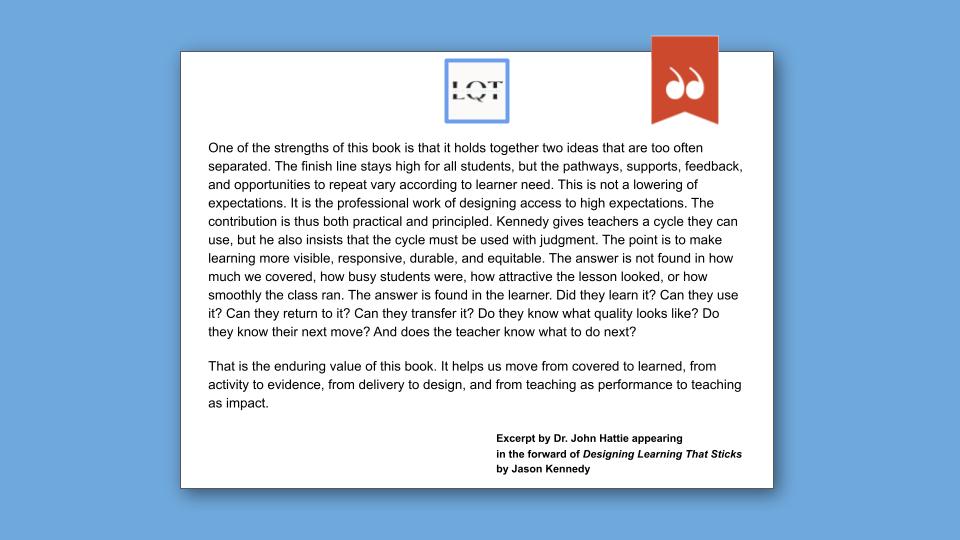
I’m excited to share that my next book, Designing Learning That Sticks: Task, Scaffold, Feedback, Repeat, is currently in the production phase! This book is a type of companion to my first book, Let’s Stop Teaching and Start Designing Learning: A Practical Guide, and takes a deeper look at the intentional decisions we make to design learning that lasts.
As I listened to these first two episodes of Sold a Story, I kept hearing ideas connecting directly to what I’ve been writing about for years. If you listen to this podcast, I believe you’ll find quite a bit that resonates with the ideas in my first book and its forthcoming companion. I’m looking forward to sharing more about the new book as it moves closer to publication!