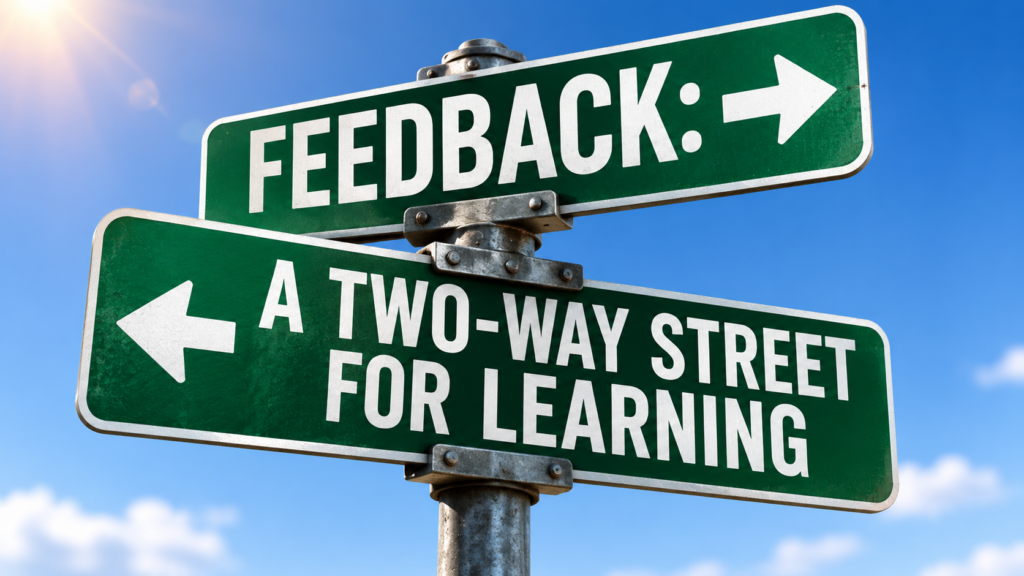
We talk about feedback a lot in education. We put it in lesson plans, professional learning, evaluation rubrics, walkthrough forms, and just about every conversation about improving learning. Most of the time, though, when we talk about feedback, we picture it traveling in one direction. Teacher → Learner
The teacher looks at the work, identifies what is going well or where something has gone wrong, and gives the learner information intended to move the learning forward. That is certainly part of good feedback. The problem is that we often stop there. A learner receives a comment such as, “Strengthen your reasoning,” “Explain how your evidence supports your claim,” or “Check your work on this step.” We have identified the problem, provided some direction, and done the responsible educator thing. Feedback delivered. Box checked.
But what happens next may be far more important than what we wrote in the first place. If the learner makes a stronger revision, that tells us something. If the learner changes almost nothing, that tells us something too. If the learner stares at our beautifully crafted feedback like we have written it in ancient hieroglyphics, we probably ought to pay attention to that as well.
Because the learner’s response is feedback. And we are the ones receiving it.
We Have Been Looking at Only Half of the Feedback Loop
A more useful picture of classroom feedback looks like this: Teacher ⇄ Learner
The teacher provides information intended to help the learner understand where the learning is and what might help move it forward. Then the learner responds through an explanation, question, revision, new attempt, error, hesitation, or demonstration of greater independence. That response gives the teacher evidence about more than the learner. It also tells us something about our original interpretation and the usefulness of the feedback we provided.
Visible Learning MetaX currently reports an effect size of 0.50 for feedback. Feedback from learners regarding teacher quality has a current effect size of 0.49. Formative evaluation, which includes teachers using evidence during learning to determine whether instruction is working or needs to change, is currently 0.39. I think the bigger idea underneath these numbers matters. Feedback should help learners make better decisions about their learning, but it should also help us make better decisions about our teaching and design.
Consider a learner writing an argument. I read the work and determine that the evidence is decent, but the reasoning is weak. So I write, “Explain more clearly how your evidence supports your claim.” Seems pretty good. The learner gets the paper back, reads my comment, and makes almost no change.
I now have a choice about how I interpret what happened. I can decide the learner ignored my feedback, did not put forth enough effort, or simply did not care enough to revise. We have all had those thoughts at one time or another. Or I can get curious. I might ask, “What did you think I was asking you to change?” The learner responds, “I know you want more reasoning. I just don’t know what more reasoning looks like.” There it is. Feedback for me.
My original judgment was probably accurate. The reasoning did need improvement. But the next step I provided assumed the learner understood something they did not yet understand. I diagnosed the problem correctly and prescribed something the learner could not use. That changes my next move. Maybe I put two examples side by side and ask the learner to identify which one makes the connection between evidence and claim more clearly. Maybe we annotate a strong example together. Maybe I model one sentence and then ask the learner to return to the original paragraph.
Then I watch what happens. If the learner revises successfully, I have received another piece of feedback. The new support appears to have been better matched to the learner’s need. That is learning for the learner, but it is also learning for me.
Learners Are Giving Us Feedback All Day Long
When educators hear the phrase “learner feedback,” it can sound like we are suggesting another survey. We already have enough surveys in education. I am not interested in handing learners a QR code after every lesson and asking them to rate my performance on a five point scale.
Learners give us feedback constantly, whether we ask for it or not. Their errors are feedback. Their explanations are feedback. The questions they ask are feedback. What they can do without us hovering nearby is feedback. What they remember three days later is feedback. Their ability to use something in a different context is feedback. Even the moment when half the room looks at us after directions with that unmistakable expression that says, “We have absolutely no idea what you just said,” is feedback. Some of that feedback is demonstrated through performance. Some of it is articulated by the learner. We need both because neither tells the complete story by itself.
A learner may tell me, “I totally get it,” and then be unable to apply the learning independently. That perception matters, but the performance complicates it. Another learner may tell me, “I don’t think I understand this yet,” and then explain the idea accurately and transfer it into a new situation. That mismatch tells me something different, perhaps about confidence, self evaluation, or what that learner believes successful learning should feel like.
This is where the learner’s perspective becomes especially valuable. It does not replace our professional judgment. It can corroborate it, complicate it, or challenge it. And sometimes we need it to challenge us.
Did My Feedback Actually Do Anything?
There is another problem with the way we traditionally talk about feedback. We tend to measure its quality at the moment it leaves us. Was my comment specific? Was it timely? Did I connect it to the learning target? Did I give the learner a next step? Those are worthwhile questions, but they still focus almost entirely on what the teacher did. The more important question comes later: What did the learner do with it?
A beautifully written comment that produces no new thinking, revision, understanding, or decision making may have been excellent advice, but it was not yet very useful feedback for that learner. That distinction is supported by research examining feedback flowing in the other direction as well. A 2025 meta analysis examined learner feedback to teachers in primary and secondary schools and found a positive overall effect on teaching quality of d = 0.27. Even more interesting to me, the effects were larger when teachers received support interpreting the feedback and making changes to practice, and when teachers discussed the feedback with learners.
Read that last part again because it gets at something we sometimes miss. Collecting information was not the end of the process. Teachers had to interpret it, respond to it, and continue the conversation. That sounds a whole lot like learning.
The Teacher Has to Be a Learner Too
For years, one of the most important ideas in Visible Learning has been the call for educators to know their impact. We cannot know our impact only by looking at what we intended to do. We have to study what learners actually experienced, understood, retained, and became able to do because of the learning we designed.
Feedback gives us one of the best opportunities to do that. When I provide feedback, I am making a judgment. I am saying, based on the evidence available to me, that this is where the learning currently is and this is something that may help move it forward.
Then I need evidence about whether I was right. Did the learner understand what I meant? Was my interpretation accurate? Could the learner act on the information? Did the next attempt improve? Did I provide too much help? Too little? Did the learner become more independent, or did the feedback create greater dependence on me?
Those questions shift feedback from a teacher-behavior into a learning process shared by both people. They also connect to something else worth paying attention to. Visible Learning MetaX currently reports an effect size of 0.96 for self reported grades, defined as learners assessing the quality of their own work or level of mastery.
The long term goal of feedback cannot be for learners to become increasingly dependent on us to tell them how they are doing. We want learners to become increasingly capable of evaluating their own work, recognizing quality, and deciding what they need to do next. That requires them to learn from our feedback, but it also requires us to learn from theirs.
Making Feedback Travel Both Ways
So what might this change tomorrow? It does not require a new program, a feedback app, or another three ring binder somebody bought with grant money. It begins with paying closer attention to what happens after we give feedback.
Instead of ending the process when we provide the comment, we can follow the evidence one step further. Ask a learner what they thought the feedback meant. Look at what changed between attempts. Ask which part of the feedback they actually used. See whether they can explain why the revision is stronger. Notice whether the same misconception appears again. Pay attention to whether a scaffold is still necessary or whether the learner is ready to work with greater independence.
Sometimes we can simply ask, “What did my feedback help you see?” Other times the learner’s work will answer the question for us. The important part is that we do something with what comes back.
If several learners misunderstand the same feedback, I probably need to examine my clarity. If learners understand the feedback but cannot act on it, they may need a model, example, scaffold, or additional instruction. If they revise successfully but cannot repeat the learning later, I need to think beyond the revision and design another opportunity for retrieval or transfer. The learner response becomes evidence for my next design decision. Then I redesign, the learner responds again, and the cycle continues.
Keep the Traffic Moving
We have spent years telling teachers they need to give more feedback, better feedback, faster feedback, and more specific feedback. All of that can help, but perhaps we have paid too little attention to what comes back in the other direction. Feedback is not finished when the teacher speaks, writes a comment, or enters something into a digital platform. It becomes useful when somebody does something with the information. That includes us.
If feedback only travels from the teacher to the learner, we are missing half of the information available in the room. Every response, revision, question, misconception, successful transfer, and moment of independence gives us evidence about the impact of the choices we made. So perhaps the next time we give feedback, the question should not only be, “What does this learner need to know from me?” We should also be paying attention to the answer to another question: What is this learner about to teach me?