They are coming back.
Some of you have already met them. Some of you are staring at a roster filled with names that will soon become faces. You have spent the last few weeks arranging furniture, preparing materials, reviewing standards, building slides, organizing resources, and making sure everything is ready for that first bell. You know what you are going to teach. You know what unit comes first. You know the standards. You probably even know where everyone is going to sit.
But how much do you know about the people who are about to sit there? Before you teach anything, you need to learn something. You need to learn them. Not the labels attached to their names. Not what last year’s teacher said about them. Not what the test score says. You need to learn the actual learners walking through your door because they are bringing a whole lot more into that room than a backpack and a schedule.
They are bringing experiences, beliefs, strengths, worries, interests, prior knowledge, misconceptions, confidence, doubt, and curiosity. We can spend the first days of school telling them everything about us and everything we expect from them, or we can start by learning something about the people we expect to learn from us.
The WHO Comes Before the WHAT
We educators love the WHAT. What standards am I teaching? What unit comes first? What assignment are they completing? What assessment are we giving? Those questions matter, but they are not the first questions we should be asking.
Before the WHAT comes the WHO. Who are the learners in this room, and what do I need to understand about them before I start making decisions about their learning?
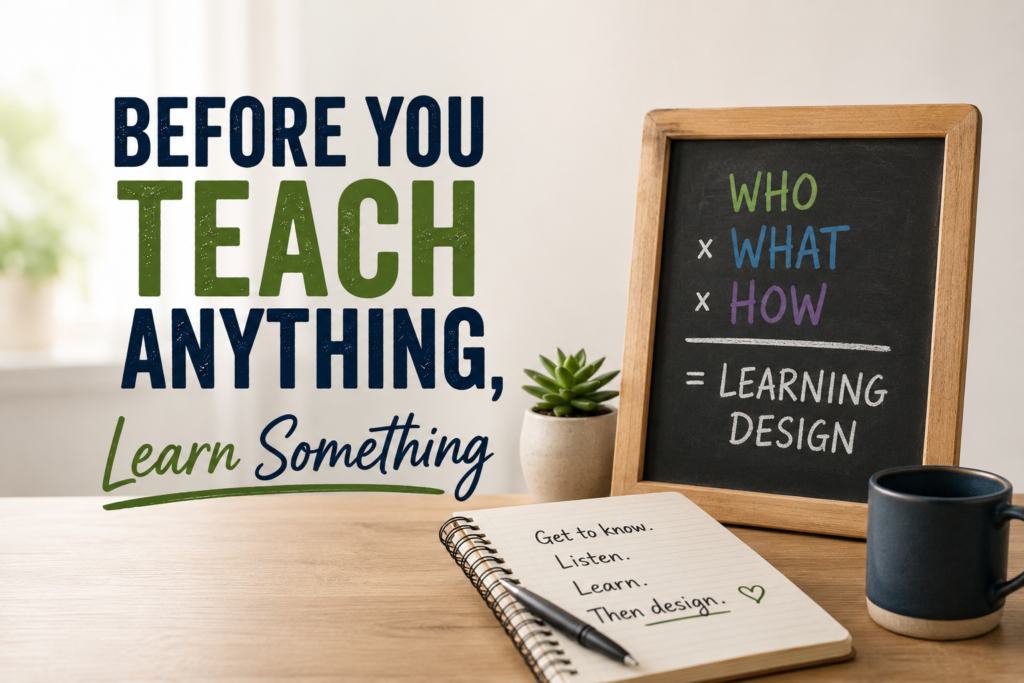
I keep coming back to a simple way of thinking about learning design: WHO × WHAT × HOW = Learning Design. WHO comes first for a reason. We cannot make the best decisions about HOW learning should happen until we understand WHO is doing the learning.
Yet sometimes we design an entire first month of instruction before we have even met the people who will experience it. Think about how strange that is. Imagine a coach creating an entire season strategy without knowing the athletes on the team. Yet in schools we sometimes say, “Here is the curriculum. Here is the lesson. Here is what I have always done.” Then the learners arrive and we try to fit them into what we already created.
Learning does not happen in some generic classroom filled with generic kids. It happens with these learners, in this room, at this moment. That should change the choices we make.
You Cannot Design in the Dark
Knowing our learners matters because learning connects to what is already there. Learners do not walk into our classrooms with empty brains waiting for us to fill them. New ideas connect to existing ideas. Experiences shape understanding. Beliefs about ability affect how learners approach difficulty. Feelings of safety and belonging influence whether someone is willing to speak up, take a risk, admit confusion, or try something that might not work the first time.
This is also why relationships and learning cannot be separated. Think about what we ask learners to do every day. We ask them to try something difficult, show their thinking, accept feedback, revise something they thought was finished, admit when they do not understand, make mistakes publicly, and then try again.
That requires vulnerability, and vulnerability requires trust. A learner who believes the adult in the room knows them, cares about them, believes in their ability, and will not embarrass them when they struggle is much more likely to take the kinds of intellectual risks real learning requires.
That is why getting to know learners is not fluff. It is not something we do before the academic work begins. It IS academic work because knowing learners helps us design better questions, better groups, better examples, better supports, better choices, and better tasks.
The company that created your textbook does not know the learners sitting in your classroom. The pacing guide does not know them. The program does not know them either. You do, or at least you can.
Learn FROM Them, Not Just ABOUT Them
There is a difference between learning about learners and learning from them. We can learn ABOUT learners from files, reports, scores, meetings, and conversations with other adults. Some of that information is important and some of it is necessary, but we need to be careful because sometimes we meet the label before we meet the learner.
Advanced. Struggling. Unmotivated. Quiet. Difficult. Behind. Gifted. We can know so much ABOUT a kid before they ever walk through the door that we accidentally decide who they are before they have an opportunity to show us.
I have always believed we teach learners, not labels. A label may tell us something about the support a learner needs, but it should never tell us what that learner is capable of becoming.
The learner sitting in front of us is another source of information, and sometimes we forget to consult them. Ask questions. Listen to the answers. Watch what they do. Give learners opportunities to tell you how they learn, what frustrates them, where they feel confident, and where they need help. Then keep paying attention because learning your learners is not a first day activity. It is a yearlong process.
Start Here
So what can we actually do when school begins? Start by having conversations that have absolutely nothing to do with content. Talk to kids at the door. Ask about the team on their shirt, the book in their hand, the game they stayed up too late playing, or something they did over the summer. Nothing fancy. Nothing scripted. Just be interested.
Then ask learners about learning. Instead of another generic getting to know you sheet asking for a favorite color, ask questions that give you information you can actually use. What do you think you are really good at? What usually helps when learning gets difficult? What makes you want to give up? What is something you wish teachers understood about you as a learner?
Those answers can become design data, but only if we use them. The point of asking is not collecting information. The point is making better decisions because of what we learn.
Finally, give learners something meaningful to learn early and watch what happens. Give them a challenge. Let them solve something, collaborate, make choices, create, explain, revise, and think. Pay attention to who jumps in, who hangs back, who takes leadership, who asks for help, and who takes a risk. You will learn more watching learners learn than you will from most information sheets.
Learn First
There is going to be pressure to get started. The pacing guide is sitting there, the standards are waiting, and there is always a lot to cover. But we have to remember what the job actually is. The job is learning, not coverage. Learning begins with learners.
So when those kids walk through your door, resist the urge to immediately show them everything you know. Spend some time learning first. Learn their names, their strengths, what makes them curious, where they struggle, what they already know, and what they believe about themselves as learners.
Then take everything you learn about the WHO, combine it with the WHAT they need to learn, and make intentional choices about the HOW. That is learning design, and that is the work.
We need to become students of our students.
We must learn our learners so learning can happen for them for sure!