
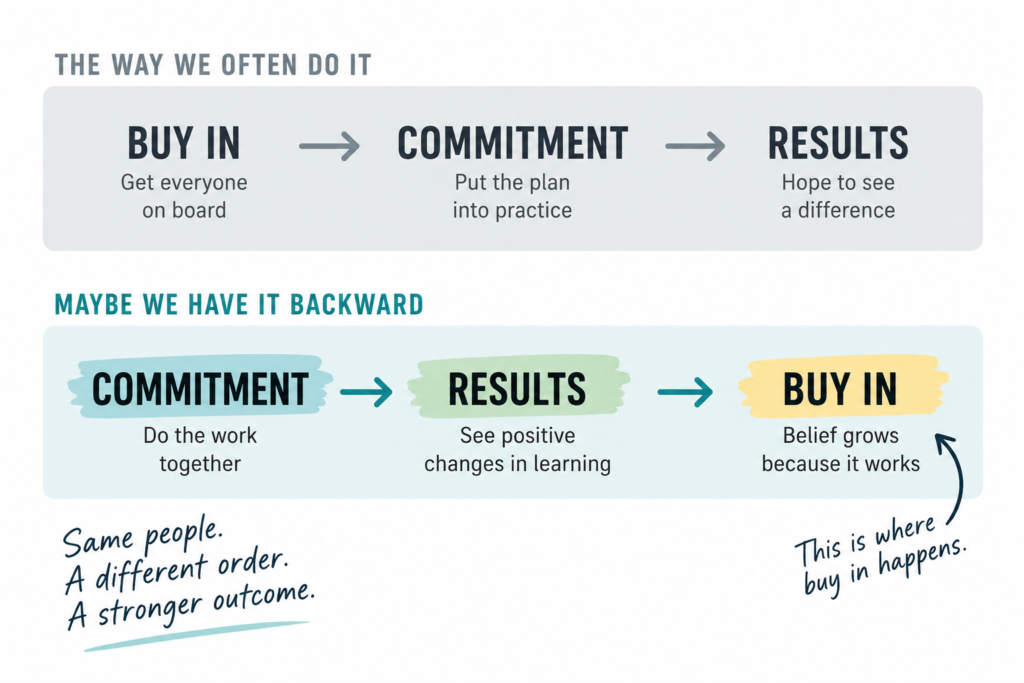
I have heard the phrase “we need teacher buy in” countless times in education. A school wants to improve instruction, introduce a new practice, or change something about the way we work, and before long someone says we have to get everyone to buy in first. The thinking makes sense. Teachers are professionals, they should have a voice in their work, and most of us have lived through enough short lived initiatives to be skeptical when the next great idea arrives.
But I am beginning to wonder if we have the process backward. We often treat buy in as the starting point when it actually comes later. Before people truly believe in a practice, they usually have to commit to it long enough to see whether it produces anything worthwhile. When that commitment starts producing better results for learners, belief in the work has a reason to grow. Which is why the real sequence is this: Commitment, Results, and then Buy in.
We Already Expect This From Learners
Think about what we ask learners to do every day. We want them to understand why their learning is important, and good teachers work hard to make that learning meaningful. But we don’t wait until every learner is completely convinced that fractions, persuasive writing, photosynthesis, or the Civil War deserves their full enthusiasm before asking them to participate.
We expect a commitment to the work. Read the text. Try the problem. Join the conversation. Use the feedback. Revise the work. Sometimes learners begin because they are interested, sometimes because they trust the teacher, and sometimes simply because participation is part of being in the room. Then they begin to see progress. A learner who has always believed she is terrible at math solves something difficult. A reluctant writer sees that his second attempt is stronger than the first. Someone who has quietly decided that school is mostly a place to discover what he cannot do finally sees evidence that he can improve.
Those experiences can change how learners approach what comes next. Success gives them something concrete to believe in, and progress makes the next challenge feel more possible. The commitment came first, but the results helped create the buy in. Adults are not all that different.
Commitment Gives the Work a Fair Chance
This is where the conversation gets harder for us as educators. Sometimes we are asked to do things we don’t immediately see value in. Sometimes the change requires more work, new learning, or giving up a practice we have used for years. We may also have good reasons for being skeptical because schools have a long history of launching initiatives that disappear before anyone has enough time to know whether they worked. That skepticism deserves to be heard, but it can’t become our permanent response to change. If we have credible evidence that a practice improves learning, at some point we have to be willing to commit to it long enough to see what happens with our learners.
There is a big difference between trying something and actually committing to it. A strategy used twice, a collaborative process abandoned after a few meetings, or an instructional practice implemented only when convenient does not tell us much about whether it works. Commitment means carrying the practice into real classrooms, working through the awkward parts, looking at learner evidence, and making adjustments instead of quitting the first time it feels uncomfortable.
Think about clearer learning targets, stronger tasks, useful feedback, purposeful scaffolds, or planned opportunities to return to important learning. None of those practices becomes effective because we nodded along during professional learning. They improve through use, reflection, and refinement. That is where results begin to show up.
Leaders Have Work to Do, Too
School leaders can’t use commitment as an excuse to push every new idea that comes along. If we expect teachers to commit to something, the work needs to deserve that commitment.
Leaders should be able to explain how the practice connects to learning and what evidence supports it. Teachers need time to learn, collaborate, try the work, and study what happens. Leaders also have to protect the focus long enough for people to get good at it. Asking teachers to deeply commit to six priorities at once usually creates shallow implementation of all six.
We also have to look at results together. Are learners thinking more deeply? Is their work improving? Can they explain what they are learning? Are they using feedback and becoming more independent? Once teachers can see those changes, the conversation shifts. The evidence is no longer coming from a presentation or someone standing at the front of a professional learning session. It is sitting in front of them in the work of their own learners.
Maybe We Need to Stop Waiting
Education is hard work. Teachers are carrying more than most people outside schools will ever understand, and leaders are trying to support schools while managing demands coming from every direction. I understand why change can feel like one more thing piled onto an already crowded day. But staying where we are has consequences, too. When learning isn’t happening at the level we want, we can point toward motivation, parents, behavior, poverty, attendance, technology, or any number of other factors that affect schools. Those realities are real, but they don’t remove our responsibility to examine the part of the learning experience we influence most directly: what we do.
Maybe we have spent too much time waiting for everyone to believe before asking anyone to commit. Perhaps we should identify a small number of practices that evidence tells us support learning, give educators the time and support to do them well, and stay with the work long enough to see what happens. Then look at the learners. If they are learning more, thinking more deeply, becoming more independent, and experiencing success they were not experiencing before, adults begin to notice. People share what worked. Teams get curious. The work starts spreading because educators can see a reason to keep doing it.
Will everyone eventually buy in? Probably not. At some point, a school with strong collective commitments has to decide whether those commitments actually mean something. We don’t need perfect enthusiasm before we begin improving learning. We need enough commitment to give good practices a genuine chance to work. When the results begin showing up for learners, buy in has a much better reason to follow.