Summer has a way of tricking us, doesn’t it? At the end of the school year, summer looks huge. It feels wide open, almost endless, as if there will be plenty of time for everything we have been putting off since sometime around February. Time to rest. Time to read. Time to sit outside and do absolutely nothing without feeling even the smallest amount of guilt. Time to clean out that closet, organize that garage, catch up with friends, take a trip, sleep late, and maybe even remember what our own hobbies used to be before education swallowed the calendar whole.
Then we blink, and the whole thing starts moving faster. The stores are suddenly full of pencils and notebooks. Our inbox starts waking back up. Calendars begin filling themselves without our permission. The back to school dreams start creeping in at night too. You know the ones. The copier is broken, your roster has 87 learners on it, and somehow you are teaching in a room you have never seen before.
Summer is quickly evaporating away, and before we know it, we will be standing in our classrooms again with new faces, new names, new energy, and new chances in front of us. That last part matters. Before we step back into the beautiful, exhausting, meaningful work of a new school year, I want to offer a challenge that is not meant to steal whatever peace you still have left. It is not a new initiative. It is not a binder. It is not one more thing piled on top of all the other things.
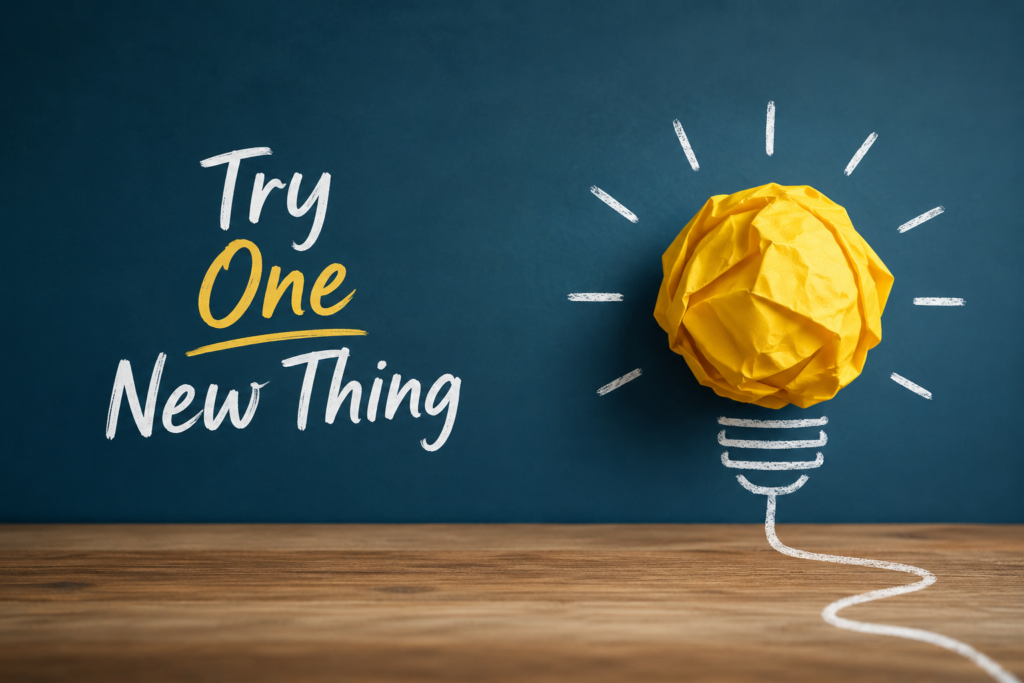
Try one new thing this year.
That’s it. One new thing you can point to later when learning improves. One new thing you can say made a difference. One new thing that reminds you we are not helpless observers waiting to see what walks through the classroom door. We are the designers of learning.
Same Plans Usually Produce Same Results
I know this is not the most comfortable thing to say, but here it goes anyway. If we go into this year planning to do the exact same thing we did last year, then we should probably expect the exact same results we got last year. GULP.
Now, before anyone throws a dry erase marker at me, I am not saying everything we did last year was wrong. Far from it. There were great things happening in classrooms everywhere. Teachers worked hard. Learners grew. Moments clicked. Lessons landed. Relationships mattered, and progress happened in ways both visible and not so visible.
But we also know there were gaps because we saw them, felt them, and carried them home with us. Some learners needed more clarity. Others needed more practice, better feedback, more time to talk through their thinking, or more chances to show what they knew in a way that was not hidden behind compliance. Many needed opportunities to actually learn instead of simply finish. And here is the truth. We cannot rely on the kids walking through the door to be different enough to close those gaps for us.
They are going to come to us like they come to us. Some will be ready and some will be nervous. Some will be confident while others will be guarded. Some will bring strong skills, some will bring gaps that feel bigger than we expected, and some will carry things we may never fully know about. But once they walk into our rooms, the learning experience becomes our responsibility to design. Not because we are miracle workers. Not because one teacher can fix every problem in education by Thursday afternoon. Not because we should carry the weight of every challenge learners bring with them. The work belongs to us because we are the ones who bridge the gap between where learners are and where they need to go. We design the learning. That is the job.
Small Changes Can Move Big Things
Sometimes when educators hear the word change, we immediately picture something massive: a new program, a new curriculum, a new schedule, a new initiative with a shiny binder and a meeting that could have been an email. No wonder we get tired before the conversation even gets started.
But that is not the kind of change I am talking about. I am talking about one intentional adjustment, one design choice, one small move that puts learning more clearly in the hands and minds of learners. Maybe it takes five minutes. Maybe it replaces something you already do. Maybe it simply makes your room feel a little more learner centered and a little less adult driven.
The right kind of small change helps learners answer the questions we should want them to answer every day: What am I learning? Why am I learning it? How do I know I have learned it? Those questions change things because they move the focus from what I am teaching to what they are learning. They make the work visible and remind us that quiet does not always mean learning, busy does not always mean learning, and completed does not always mean learned.
I have been guilty of confusing those things. A quiet room can look amazing from the hallway with learners sitting, pencils moving, work getting done, and the teacher in control. Everything appears to be working, but appearance is not the same as evidence. Can learners name what they are learning? Can they show it? Can they explain how they know they are getting better?
That is where one new thing can matter. It can turn a routine into a learning opportunity, help learners see what success actually looks like, and give us better evidence than simple completion ever could. One new thing can help us ask better questions, collect better information, and design better experiences without requiring us to reinvent ourselves overnight.
And no, it does not have to be perfect. Please do not wait for perfect because perfect is where good ideas go to die while we keep doing what we have always done. Try it, reflect on it, adjust it, and try it again. That is how we grow as professionals. That is also how we model learning for learners. We are not stuck. We are not finished. We are not just surviving another year. We are building something better.
A Few New Things Worth Trying
So what could that one new thing be?
Start with clarity. Choose one lesson each week where the learning target is not just written on the board, but actually used by learners. Have them say it in their own words, connect it to the task, and return to it at the end to explain whether or not they met it. This is not about checking a box. It is about giving learners a finish line they can actually see.
Or try changing the task. Take one assignment you have used before and ask yourself a simple question: Does this ask learners to show learning, or does it only ask them to complete work? That question can sting a little. I know. But it is a good sting. A helpful sting. A learning design sting. Instead of answering questions at the end of a reading, maybe learners create a claim and support it with evidence. Instead of filling in blanks, maybe they build an explanation. Instead of repeating information, maybe they apply it to a new situation where they have to think, decide, and revise.
You could also try adding a success criteria. Give learners something concrete to look for in their own work so quality is not a mystery known only to the adult in the room. No mystery grading. No mind reading. No, “I will know it when I see it.” Let them know what success looks like before they begin, and then give them time to check their work while improvement is still possible.
Another option is to give learners more opportunities to talk about their thinking. Not just talk to talk. Not group work because a lesson plan needed a collaboration box checked. Real talk. Purposeful talk. A quick turn and talk where learners explain a process. A partner check where they compare reasoning. A small group discussion where every learner brings evidence to the table and leaves with a clearer understanding than they had before.
Or maybe the one new thing is how class ends. Instead of the final minute becoming a mad dash of bags, papers, chargers, and the universal mystery of disappearing pencils, use it to make learning visible. Ask learners to write what they learned, where they struggled, what question they still have, or what they would do differently next time. One minute can give you evidence you did not have before.
None of these suggestions require you to rebuild your entire classroom from scratch, and that is the beauty of it. You are not being asked to become someone else. You are being challenged to try one thing that helps learners learn more visibly, more intentionally, and more successfully. One thing is doable.
The Year Ahead Is a New Opportunity
The summer may be evaporating, but that does not mean the opportunity is disappearing. Actually, it is arriving. A new year is coming, and with it comes the opportunity to decide what kind of learning experience we are going to design. We can repeat last year and hope the results somehow change, or we can try one new thing. A new routine. A stronger task. A clearer target. A better way to make learning visible. A more intentional way to give feedback. A better way to help learners understand the goal before they start running.
That is the challenge. Not everything. One thing. Pick it. Plan it. Try it. Watch what happens. Then adjust. Learning is still the job, and the learners walking into our classrooms this year deserve educators who believe tomorrow can be better than yesterday.
So enjoy what is left of summer. Rest a little more. Laugh a little more. Sit outside a little longer. Then when the year begins, walk back into that classroom with one new thing ready to go. Not because you have to. Because you can, and because that one thing might be the thing that changes everything.